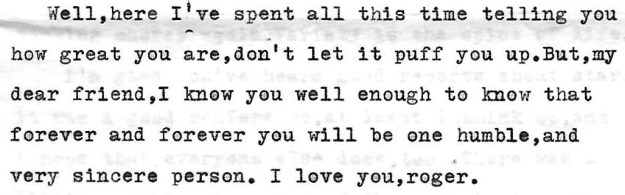
Above is an excerpt (the peroration) from a letter I received from a friend, Kathy Phair of Harvard, Massachusetts, in July 1964. At the time of the letter, Kathy was working at a Girl Scout camp in Harvard, and I had a summer job on Cape Cod.
Kathy may have been in love with me, but I never realized this, if it were true. She was, when we first met, the girlfriend of a good friend of mine. We (she and her boyfriend Tom) used to do things together as a threesome. We had some wonderful times.
Why post this quote? Some will say it is narcissism, egotism, on my part.
Undoubtedly some of my spiteful relatives will.
I am posting it because I know that, for a fact, I haven’t changed, as my wife and some of my close friends realize. The part about being “one humble, and very sincere person” meant and still means a lot to me.
The last time I saw Kathy was in my early twenties. She came to visit me where I was living then, near Boston. We went together to a poetry reading by the poet L. E. Sissman in Kathy’s hometown, Harvard.
Kathy died shortly afterward (at which time she was married) from an illness of long duration which had begun at an early age. She never complained about it.
In the spring 1966 semester, I took the course History 124a, “Feudalism: Medieval Society and Political System,” at Brandeis University.
The course was taught by Professor Joshua Prawer. Prawer, who was a visiting professor on leave for the academic year, was dean of the Faculty of Humanities at Hebrew University in Jerusalem. He was an internationally known medieval historian. Books which he later published include The Latin Kingdom of Jerusalem: European Colonialism in the Middle Ages, The World of the Crusaders, Crusader Institutions, and The History of the Jews in the Latin Kingdom of Jerusalem.
I took great courses and did well in my first two years of college. I had placed out of a few required core courses, which enabled me to take several higher-level elective courses.
Despite enjoying the courses — greatly — I was a shy, inhibited person in those days, and I was unhappy with the social milieu at Brandeis. I tended to be repressed and taciturn. And diffident among other students and probably in class as well. (I can’t exactly recall.)
I recall that there was no final exam for Professor Prawer’s course, in which I received a final grade of B. There was a required term paper.
My term paper was based on the English historian Doris Mary Stenton’s English Society in the Early Middle Ages (1066–1307), which was published in 1951 as the third volume of the Pelican History of England. She was the wife of the medievalist Sir Frank Stenton, author of Anglo-Saxon England, c550–1087, Volume II in the Oxford History of England.
I recall that I worked fairly hard on the paper and enjoyed Doris Mary Stenton’s book. I was very interested in medieval history and society. I seem to recall that my paper mostly amounted to summarizing the contents and findings of the book and I thought that, on that account, it was probably not a great paper.
To my great surprise (really and truly), I got the paper back with only the following (no other comments or marks): an A+ on the top of the first page and the professor’s comment beneath, “Why didn’t you open up more in the seminar?”
If I may say so without bragging, what this seems to show is that a good writer can write well at any time about almost anything, and under constraints and deadline pressure. It must have been my writing that impressed Professor Prawer. I don’t recall that the paper was otherwise remarkable.
Sixth Avenue, New York City; Friday afternoon, November 30, 2018
I took this photo of Sixth Avenue on my way home on Friday afternoon.
It’s been raining a lot in the City this week.
Rain can be a slight inconvenience, like other weather phenomena, but I never really minded it. It can be “nice.”
When I was very young, my mother took me once to my eye doctor, Dr. Johnson, in Boston on a weekday. We went by subway.
The appointment lasted a long time. Going home in the late afternoon, it was dark and rainy. I didn’t mind. I loved having my mother all to myself. When we got home, she put me to bed. She was so kind. She kept saying that I was cold and wet and that I must be very tired: it had been such a long day and we got home late.
Re this photo of Sixth Avenue, this street scene, it reminds me of Herman Melville’s words (in Moby-Dick): “a damp, drizzly November in my soul.”
Thanks to the Good Lord that it came upon me once when I was first living in NYC to read Moby-Dick, in a library copy. What a book!
Whenever I find myself growing grim about the mouth; whenever it is a damp, drizzly November in my soul; whenever I find myself involuntarily pausing before coffin warehouses, and bringing up the rear of every funeral I meet; and especially whenever my hypos get such an upper hand of me, that it requires a strong moral principle to prevent me from deliberately stepping into the street, and methodically knocking people’s hats off—then, I account it high time to get to sea as soon as I can.
— Herman Melville, Moby-Dick; CHAPTER 1. “Loomings.”
I am blessed to come from a family that is very verbal, that delights in oral and written exchanges and expression and in word play. It seems as if they always put things just right, and often they amuse or provide a pleasant surprise with verbal ingenuity.
When I was in college, my brother and his wife gave me a book as a Christmas gift: Samuel Eliot Morison’s The Oxford History of the American People. On the flyleaf, my brother wrote an inscription: “To the effervescent pedant / With love”
I thought of this because of an email exchange I had with my brother this morning.
as follows: “The PC types are all for conversation (of the wilderness and the natural environment). Why do they want to tear asunder our language? Like nature, it should be conserved, which does mean embalmed or ossified.”
Reminds me when you confused “martial relations” with “marital relations,” an apt malaprop that sent Mom into gales of laughter — loving laughter because in part she was enjoying your early advanced vocabulary.
I had forgotten how I used to get “martial” and “marital” mixed up.
Sometimes, I would make words up, which amused Mom … I used to say, “It’s just the INTRACITIES of life.”
Once I wrote Mom a letter using several big words I had just learned. I said that if she had no objection, I would DESCANT upon a few things. (To descant means to talk tediously or at length.)
She wrote back a letter beginning with, “So, cant me no descants.” She loved word play.
On November 22, I saw a solo piano concert by Sachiko Furuhata-Kersting at Carnegie Hall. Her program consisted of:
Beethoven’s Piano Sonata No. 14 in C-sharp Minor, Op. 27, No. 2 (“Moonlight”)
Beethoven’s Piano Sonata No. 21 in C Major Op. 53 (“Waldstein”)
Schumann’s Fantasy in C Major, Op. 17
Chopin’s famous Scherzo No. 2 in B Minor, Op. 31
I have a particular fondness for the first two pieces, especially the “Moonlight” sonata (though I love the “Waldstein” sonata too, especially the third movement).
The “Moonlight” sonata has a unique structure, as is explained in a Wikipedia entry:
Although no direct testimony exists as to the specific reasons why Beethoven decided to title both the Op. 27 works as Sonata quasi una fantasia, it may be significant that the layout of the present work does not follow the traditional movement arrangement in the Classical period of fast–slow–[fast]–fast. Instead, the sonata possesses an end-weighted trajectory, with the rapid music held off until the third movement. In his analysis, German critic Paul Bekker states: “The opening sonata-allegro movement gave the work a definite character from the beginning… which succeeding movements could supplement but not change. Beethoven rebelled against this determinative quality in the first movement. He wanted a prelude, an introduction, not a proposition.”’
I thought it was a splendid performance, though it seemed to me that Ms. Furuhata-Kersting could have played the second movement of the “Moonlight” sonata (marked Allegretto) a tad more softly.
I was hoping there might be a review of the performance. I was dazzled by her keyboard technique, but I am no expert when it comes to performance mechanics and performance styles. I only know, insofar as I know anything, what I experience as a listener.
Nevertheless, I was thinking about the piano as an instrument, why I love it, what seems to make it so compelling and powerful as a solo instrument. I was thinking about the following:
— it is played with TWO HANDS, which can play off against one other. This is key. It must be incredibly difficult for a pianist to develop the ability to do this;
— it’s a percussive instrument. The keys make the hammer strike with such force. You get hammering sounds, banging sounds. You also get soft, tinkling sounds. It’s hard to fall asleep!
There is such richness and variety of sound in one instrument, such emotional range. (I am speaking simply as a non-specialist listener.)
To hear such things, you almost have to hear a live performance. I was reminded of this when hearing what was Ms. Furuhata-Kersting’s debut Carnegie Hall performance.
I couldn’t help but think — as is the case with me and everyone else when it comes to music ranging from classical to pop, it seems — of the circumstances under which I first heard the “Moonlight” sonata. I had just begun to become a full-fledged classical musical lover.
It was the summer of 1964. My parents had bought me a portable stereo as a present upon my high school graduation. It seemed like such wonderful gift. I took the stereo with me to Cape Cod, where I had gotten my first ever paid employment, a summer job as a night watchman and night clerk at the Oak Crest Inn in Falmouth Heights, Massachusetts, a ramshackle summer hotel of sorts that was beginning to show its age. Rooms, if I recall correctly, were priced at four or five dollars a night. The owner, one Paul Wassseth, was a would be Donald Trump. There were a couple of guests who took a room for the entire summer and got special treatment.
My hours were 9 p.m. to 7 a.m. seven days a week, at a salary of thirty-five dollars a week, plus room and board. The food was barely edible, but who was complaining? What does a teenager know about diet or cuisine? I actually liked the job. In the morning, I would eat breakfast, cooked by the crusty old cook Leo (who used to delight in making off color remarks and dirty jokes at the waitresses’ expense), with the hotel staff (all female, other than myself and Leo, consisting of waitresses and chambermaids) just reporting for work. Then I would go upstairs to my “bedchamber,” a tiny little room of sorts in an attic that you could barely fit into to. I would crawl into bed and sleep for only a few hours, then get up and go to the beach.
I would fall asleep in the early morning (post breakfast) listening to my precious new stereo. Often, I would play an LP with a performance by Rudolf Serkin of Beethoven’s “Moonlight,” “Pathétique,” and “Appasionata” sonatas.’
I have never forgotten Serkin’s performances, and still prefer them to all others.
A final note that may seem trivial. When Ms. Furuhata-Kersting came out to play a second encore, someone approached the stage and handed her a bouquet. She put the bouquet at her feet, sat down at the piano bench, and began to play. I would have probably have done more or less the same thing, and have done sillier things often in similar situations. People have called me inattentive, so that I will forget (or neglect) to tie my shoes or put something down in an odd place in public and forget that I put it there — as if I seem at times to be at sea. I plead guilty. To her, the important thing was the music. Who knew what to do with the bouquet?
It usually is the case that if two people don’t get along, they can’t have a successful working relationship.
This applies to an instructor and a student.
If the thing being taught is something technical, you would think that if the instructor has the knowledge and expertise, personality wouldn’t matter.
It does for me. I have had experiences taking lessons (briefly) in swimming, tennis, and piano, all of which didn’t work out mostly because I could not establish rapport with the instructor.
This was true of George Cohen of Newton, Massachusetts, a well known and very successful piano teacher.
My father, who became a professional pianist and himself a piano teacher, was a student of Mr. Cohen in his youth. My younger brother took lessons with Mr. Cohen for years and was one of his best students.
I myself decided that I wanted to try taking piano lessons for a second time when I was a junior in college. I had taken them briefly at age eleven with a very nice, attractive, and vivacious Japanese woman, Marsha Fukui, in Cambridge, Mass. We hit it off, but I lost interest in piano after a few months and stopped taking lessons.
I tried again in my late teens, when I was in college, with Mr. Cohen. I thought the fact that I was my father’s son and that my father must have been one of his best students would have meant something, also the fact that my younger brother was his student for a long time. This didn’t seem to matter to Mr. Cohen. Personal relationships were not of interest to him. One could say, why should they matter? You were there to learn how to play the piano. But in my case — from my perspective — such things are very important. I have to feel connected to the other person, have to be able to make conversation. If I don’t, I can’t get anywhere with them.
But that’s not the key point of this post. I wish to share a couple of amazing, serendipitous things that happened to me. One involved my lessons with Mr. Cohen.
Mr. Cohen kept telling me that I needed to strengthen my fingers as an older piano student. He said that stiffness in the fingers (they are, apparently, much more limber in a grade schooler) was a problem that had to be overcome if I was ever going to make progress. He told me to take a book and put it over my hand when playing, as a finger muscle strengthening exercise. So, I took a book at random off the bookshelf in the living room of my home and used it when practicing. A while later, I happened to look at the book. The title was The Physiology of Piano Playing.
A totally coincidental occurrence. What were the odds that that would be the book I would use?
The other anecdote involved, indirectly, my former therapist, Dr. Ralph Colp, Jr.
From time to time during the course of our therapy sessions, Dr. Colp, who was a prolific writer and well known scholar, would ask me to do unpaid research for him. I remember once when he was writing an article updating some aspect of the psychiatric literature and he asked me to make an inventory of new publications in the field.
Dr. Colp’s fees were every low, well below professional norms. He made it clear to me personally and also in comments he made to interviewers that he was not in medicine for the money.
Perhaps he regarded “hiring” me to do research as a form of barter, with the research amounting to partial payment. But he only asked me to do it when he was stumped by something and absolutely could not find anything.
I told him that I was flattered to be asked. Yet, sometimes I was thinking, what will he ask me to find now? He always gave me the hardest things to look up.
Often, the research concerned, usually indirectly, Charles Darwin, Dr. Colp’s major research interest, about whom he wrote two books and many articles.
Dr. Colp was interested in learning everything he could about Darwin’s personal (as well as his scientific) life, including how he spent his leisure time and what his tastes in books (e.g., novels) and music were. He had found out that Darwin liked a popular song of the Victorian era, “Will He Come?,” composed by Arthur Sullivan (of Gilbert and Sullivan fame).
Could I find out where the lyrics came from?
It was known that the lyrics to the song were by Adelaide Procter. Adelaide Anne Procter (1825–1864) was a very popular poet of her day; she was the favorite poet of Queen Victoria. She burst on the literary scene as a teenager. She died of tuberculosis at age thirty-nine.
So, what poem of Procter’s were the lyrics to the song taken from? Dr. Colp, like me, was a stickler for details. He wanted to be exact.
I couldn’t find out what poem of Procter’s the lyrics came from. She published three books of poetry in her lifetime. There is no poem with the title “Will He Come?”
It seems that it would have made sense for me to consult her books, but they weren’t available to me. I cannot remember why I didn’t. This was pre-internet days. Somehow, I found out that Procter had known Charles Dickens, who admired her work, and that some of her earliest poems had been published in Household Words, a weekly magazine edited by Dickens. (I doubt that nowadays many people know that Dickens was an editor.)
I went to the New York Public Library and put in a call slip for several issues of Household Words from the 1850’s. A big fat volume with a faded green cover was handed over to me. It was comprised of several issues of the magazine that had been bound together into a single volume. The pages were old and showed their age.
I placed the big, weighty book on a table in front of me and opened it carefully, not wanting to damage it. I opened it at random to a page somewhere in the middle.
On that very page was THE poem. Miss Procter’s poem. Published under the title “Hush!”
The exact same words, verbatim, as the lyrics in the Arthur Sullivan song.
How had it happened that I had requested the right volume of the magazine, and then, amazingly, opened to the very page on which there was not only a poem by Procter, but the very poem I was looking for?
“I CAN scarcely hear,” she murmured,
“For my heart beats loud and fast,
But surely, in the far, far distance,
I can hear a sound at last.”
“It is only the reapers singing,
As they carry home their sheaves,
And the evening breeze has risen,
And rustles the dying leaves.”
“Listen! there are voices talking.”
Calmly still she strove to speak,
Yet her voice grew faint and trembling,
And the red flushed in her cheek.
“It is only the children playing
Below, now their work is done,
And they laugh that their eyes are dazzled
By the rays of the setting sun.”
Fainter grew her voice, and weaker
As with anxious eyes she cried,
“Down the avenue of chestnuts,
I can hear a horseman ride.”
“It was only the deer that were feeding
In a herd on the clover grass,
They were startled, and fled to the thicket,
As they saw the reapers pass.”
Now the night arose in silence,
Birds lay in their leafy nest,
And the deer couched in the forest,
And the children were at rest:
There was only a sound of weeping
From watchers around a bed,
But Rest to the weary spirit,
Peace to the quiet Dead!
The other day, I used a cliché in conversation with a friend. I had shared an audiotape of an interesting lecture with him. “If you don’t find it interesting,” I said, “I’ll eat my hat.”
Afterwards, I got to thinking about a remark a friend of mine, the poet Charles Pierre, once made to me.
In the preface to his Collected Stories (1978), the author John Cheever wrote: “These stories seem at times to be stories of a long-lost world when the city of New York was still filled with a river light, when you heard the Benny Goodman quartets from a radio in the corner stationery store, and when almost everybody wore a hat [italics added].”
Alluding to this, my friend Charlie observed that this indicates something that was true of what he called the “New Yorker writer” and New Yorker stories.
“They trade off on what you already know,” he said. “It’s a commonplace that men used to wear hats.” The implication: such stories are not really original in content; they don’t take us into new realms of consciousness, thought, or experience.
Another thought, a memory, about hats occurred to me because of my friend’s jest the other day.
When I was in the seventh grade, I rode a bike to school every day. It was freezing cold in the winter months. We lived in New England. Often, I would get to school and would be rubbing my hands at my desk; they would seem almost frostbitten. There would be tears in my eyes.
I didn’t wear gloves; nor, for the most part, did I wear a hat.
Actually, I had a knit cap. My mother would insist that I put in on every morning.
It was probably something stupid such as that I didn’t want to mess up my hair (slicked with hair tonic). That must have been the reason. Anyway, I didn’t want to comply. But I would give in and put on my hat.
When I got just past our front yard, I would take the knit cap off and stick it my back pocket.
My mother in later years would joke with me about this. She said that she would be watching me, through the kitchen window, leave for school. (She was the solicitous type — although she was not overbearing — and undoubtedly wanted to make sure I got off okay.) She said she would be amused to see me take my hat off, without fail, when I thought I was out of sight.
I had a somewhat remarkable experience in connection with a memory today.
I had a mild, temporary disappointment once. It was over 50 years ago.
My parents were going out somewhere for the evening. I hesitated and then said to my mother, “It’ll be okay. I will put on my shining visage,” meaning she didn’t have to worry: I accepted the setback and would not let it get me down.
What I meant was, I’ll put the best face on things.
My mother was affected; she liked words herself and liked the way I invented my own locutions. She felt better about having had to disappoint me. (I do not recall details, but I think it was a situation where she informed me about something that was a negative. I think she was the intermediary.)
“Shining visage” means something like beaming, smiling face.
My mother was touched. She said that’s so like you.
I was ransacking my brain today trying to think, what was the phrase? I drew a blank.
I told myself, you can remember … keep trying.
I thought it might have been something like blithe spirit. That didn’t seem quite right.
I looked in an online Thesaurus for an adjective that means cheerful, buoyant, or sunny. Then a NOUN came to me: visage. Whereupon shining came back to memory within a minute or two.
Memory works by association.
The memory, the memories are there, in one’s brain.
I was miserable and lonely during my freshman orientation at Brandeis University. Recently, I read a newspaper article indicating that many college students, much more than would be expected, experience acute loneliness when they begin college.
I had been assigned to a dormitory with mostly upperclassmen. The dormitory was broken up into suites, considered innovative for its time, with six or seven rooms sharing a common area. My suitemates knew my new roommate to be B______. They kept saying, “Where’s B_____? He hasn’t shown up yet?”
The mysterious B______ hadn’t appeared.
Exhausted from a week of orientation activities, and depressed, I crawled into bed at 9 p.m. on Sunday night, at the end of orientation week, and went to sleep.
Within a half hour or so, I was awakened by someone entering my room. It was B______, my new roommate, moving in with all his stuff. (He had a lot.) I got up immediately, flustered and embarrassed. He apologized profusely, and kept apologizing, for waking me up.
I kept apologizing myself, in turn, telling him he hadn’t bothered me at all, that I rarely went to bed that early, but had happened to this time, and that it was nice to meet him.
I was sure he thought that I was a real square and loser for going to bed so early; hence my embarrassment.
My roommate was African American. No one had said anything to me about my new roommate’s race, but it was a matter of indifference to me and I barely noticed it. I was pro black and pro civil rights. I had had limited experience with African Americans, but what limited experience I had had had been very positive. Most of it was with African Americans, lay advisors and fellow youth group members, in my church youth group.
A few weeks before the start of the academic year, my freshman year, I received a questionnaire from the college housing office in the mail. The questionnaire concerned one’s choice of a roommate. Did I have a preference as to religion (my roommate’s)? Dining preferences (kosher or non-kosher)? Recreational interests? And so on.
It took me two minutes to fill out the form, as it were. I left all the lines blank and wrote on it, “I have no preference as to roommate.”
My reasoning, which is very consistent with the beliefs and practices I have always adhered to, was that one cannot, and should not, chose friends and associates based upon external criteria such as religion, national origin, political views, etc. How can one tell if one is going to like a person or click with them based on such ridiculous criteria, is what I thought. One should be open, in principle, to anyone, until such time as they prove to be not compatible with you, as far as you are concerned.
He was highly intelligent, brilliant. I half realized this, but did not fully appreciate it at the time.
He could be witty. He had a sense of the ironic.
He was soft spoken and very polite, which seemed to reflect (as I am certain was the case) that he was well raised. At the same time, paradoxically, he could be a bit cocky, thinking, not without justification, that he was cool. He was kind of dapper and suave, but by no means a gladhander or a phony. We never talked about the opposite sex, but he had a way with the ladies.
He had grown up in Roxbury, Boston’s black ghetto. I have learned this and other things about his early years by Googling him, but at the time we attended college, we did not discuss our families or upbringing. In fact, we didn’t really have deep or serious discussions. He treated me with respect and, I realize, eventually, came to admire some things about me (including my intelligence and studiousness), but he wasn’t interested in getting to know me. I never asked him much about himself, which was unusual for me in relating to other people. This seemed to not be the case because we did not have this type of discussion. He sort of put up with me as a roommate, but it was clear he wasn’t thrilled with being stuck with a freshman for a roommate. It wasn’t in the cards for us to become close friends.
My mother said to me, when I told her about my new roommate, “You must invite B______ to dinner.” This never happened, meaning I never got around to inviting him. Somehow, I felt intuitively that B______ wouldn’t be thrilled to be invited by me (which was not an indication of disdain or dislike per se).
B______ used to say to me, “how do you feel about rooming with a spook?” Spook was a new word for me. I think he saw me as a typical white middle class suburban kid. In a way, he was stereotyping me.
I have learned things about B______ that I never knew. He wrote an autobiographical sketch of himself that was posted on line.
He grew up in Roxbury, as noted above, in the 1950’s; it wasn’t a nice neighborhood then. He was one of six children. His father was a mail carrier.
His intelligence was noticed early and he was admitted to Roxbury Latin School, Boston’s best high school. I found out only recently that a major influence on him, a teacher who provided great encouragement and steered B______ to college, probably Brandeis, was Sid Rosenthal, chairman of the English Department at Roxbury Latin.
What a fact! I didn’t know.
Sid Rosenthal, an outstanding teacher who was Jewish, lived in Newton, Massachusetts. My father, in those days, would spend a couple of days every week on the road, making “house calls” to respectable suburban communities as a piano teacher. He taught Sid’s children piano for many years, and my father and Sid became friendly.
And, Mr. Rosenthal, through in service summer courses for teachers, became acquainted with Robert Tighe, my and my two brothers’ English teacher at Canton High School in Canton, Massachusetts. Mr. Tighe was also a department chairman and outstanding teacher. The cliché “it’s a small world” seems to fit here.
As I have said, my roommate B______ and I never knew of or discussed these connections. I think it would have ameliorated our relationship.
He got an 800 on his mathematics achievement test (administered by the College Board). He never bragged about this or told me.
He went on to have a distinguished academic career as a professor of computer science.
When I knew him, he did not seem to have much aptitude for languages (in contrast, as I viewed it, to myself). He hid his lamp under a bushel, as they say. In later years, I have learned, he has frequently traveled to China and learned Chinese, no mean feat.
With his high achievement test score, he would have seemed to be a very desirable applicant. He said in a blog post that he chose Brandeis because of the reputation of its mathematics department and also because it was regarded as being liberal. He made it clear that he was speaking, not only of the type of liberal mindedness that bespeaks openness and tolerance in the abstract, in general, but also, specifically, about a liberal stance on race.
B______, as I remember him, as seems to be true of many of the people we meet on life’s journey, was quite a character.
He had a squeaky, high pitched voice. He kept late hours. He was often absent from our room and would hang out with other students in a lounge on the ground floor. He would disappear, saying to me when exiting our dorm room: “Gotta grind.” To grind was a commonly used expression for studying that I first learned from him.
He hung out with math majors. They would study together and share class notes and assignments, as well as textbooks, late into the night. His math major friends were all white guys, which was not surprising. There were hardly any black students at Brandeis then. I also had the impression, feeling, that B______ was thrilled at just being in college. It had happened to him, the first member of his family to attend college, and it was to him a sort of miracle that he was there, and a thrill to be engaged in intellectual activity. He never said this. I just intuited it.
One way in which I clearly seemed to be superior, intellectually, to B______ was in the areas of culture, in depth and breadth of knowledge of the humanities. During the year I roomed with him, he took Music 1, music appreciation. He seemed to have had no prior acquaintance with classical music (which was true of most Brandeis students), unlike me. While preparing for a final exam, he kept playing Mozart’s symphony no. 35 (Hafner) over and over again on a portable record player. I would play it repeatedly when he wasn’t — it was a new piece to me that I liked. He was bemused. He didn’t mind it, but I think he was thinking, why is he so interested in the piece? He doesn’t have to take the final.
B______ was taking first year German. Because it was a language math majors were told it would be advantageous to take. I wanted to write a letter of reply to Joe, mentioned in my post at
a guy from Germany whom I had met during high school at a religious youth group conference, and asked B______ if he could translate my letter for me.
B______ was at first amused and incredulous when I asked him — it was a simple letter. I think he was also flattered, surprised to be asked. He duly translated the letter into German for me.
As noted above, our suite in the dorm had a common area. Joe, the janitor (not to be confused with Joe, the guy from Germany), would take breaks there and talk with us students. On one occasion, we were talking about something of a historical nature concerning World War II. It was of a time representing Joe’s generation.
Joe made a factual statement or claim that I knew was wrong. I said something to him politely such as, “I don’t think that’s correct, Joe. I think it was …”
When we got back to our room, B______ admonished me sternly. “Don’t you realize that he’s not educated? You hurt his feelings.” B______ must have had his own working class, non-college educated parents in mind.
I said nothing. B______’s remarks, while well intended, were uncalled for. He didn’t realize that I was capable of considering such things, but that I felt that, by respectfully disagreeing with Joe, I was actually showing respect for him as an interlocutor, not demeaning him. I think that B______ viewed me as the pointy headed type without a clue as to human relations.
He never appreciated, for the most part, my own personal depth. Never took my measure. We did not room together after the first year. I would see him from time to time in the library where he had a part time on the circulation desk. He would ask me, “What’s up, Roger? You gonna make the dean’s list this semester?”
Once, during the end of my freshman year, I made a witty, ironical remark to B______ sizing up a particular situation, something I am capable of. B______ said, without hesitation, something I have never forgotten: “Roger, you really do know what’s going on, but you act like you don’t.”
It’s one of the truest things about me someone else has ever said.
We had to wear different undershirts (not T-shirts) and we had to wear flannel leggings which were itchy when we went out to play in the snow. We wore caps with snaps around the chin. We had no TV and a big radio (console) in the living room that I used to listen to on Saturday mornings. Cowboys and cowboy guns were very popular with almost all kids (including girls). Kids used to love to dress up in cowboy clothes and to wear toy guns with holsters (and toy bullets, preferably silver).
The cars had a funny car smell to them. They had running boards and were curved on top and were not at all compact. (Today, they would be called “gas guzzlers.”) You could take streetcars practically everywhere: they were made of wood, not steel. A streetcar or subway ride cost a nickel.
It was easy to get carsick and there were no superhighways, so it took about twice as long to get everywhere — — like about two hours by car to my grandmother’s in Danvers, a trip that would be about an hour today.
A lot of dress up clothes were woolen, such as kids’ suits. We wore suits to church on Sunday. Girl s wore dresses a lot (to school), but it was okay for them to wear pants for play.
They still had steam trains: I remember taking one to Danvers, Mass. (my mother’s hometown) from North Station in Boston. It was really huffing and puffing (I recall that before we boarded).
Once my father took us all out to dinner on Mother’ s Day. It was rare to go out to eat. We went to an Italian restaurant in the North End. I bet the whole meal for the family was less than $10, well not more than $20 (at least). Julius Larosa (an Italian singer) was very popular. So were “How Much Is That Doggie in the Window?” “Side by Side,” and a lot of other corny songs. Rock-and-roll really hadn’t been invented yet. Johnny Mathis was also very popular, and Pat Boone soon would be (in around 1956).
Gene Autry was real popular. So was the Lone Ranger. And people were afraid of the Reds (as Russian communists were then called).
There was a popular TV show called “I Led Three Lives” about a man who was continually fighting against Russian spies, but he worked undercover. and no one but his wife knew what he was really doing.
People still got the electric chair a lot (death penalty): it wasn’t in the news all that much, but it was scary to contemplate, and I recall that crime and jail seemed pretty awesome and scary (but not attractive to me personally). I remember reading about the Brinks robbery, which was a big deal when it happened in Boston (in around 1954).
I remember the big black headlines the day Red Sox first baseman Harry Agganis, a recent college graduate and former football star from Boston College, died of a heart condition — — I believe the headline said, “Harry Agganis is Dead!” It seemed so sad that it was impressive.
TV started getting popular when I was 7 or 8 or so. but we didn’t get a TV until slightly later. “Howdy Doody” was an incredibly popular TV show that every kid loved. I thought Phineas T. Bluster, a cranky old guy (puppet) with side whiskers, was a riot. Everyone loved the Lone Ranger and Tonto. Later the Disney show The Mouseketeers was a big hit. Everyone wanted to join the Mickey Mouse Club and everyone was in love with Annette Funicello. Davy Crockett was enormously popular, and every kid (every boy, at least) had to have a coonskin cap. Later (like everyone else), I was enthralled by the quiz shows and couldn’t believe anyone could actually win the incredible, unfathomable sum of 64.000 dollars (Someone finally actually did, to my astonishment.) I remember watching American Bandstand (and a precursor show on local Boston TV) in the mid- to late-50’s and thinking, these kids are incredibly cool, as I thought were DJ’s (disk jockeys). “Cool” was a popular word then, and no one wanted to be thought “square.”
A lot of people still washed their hair with soap. I thought we were getting sort of fancy and felt a little sissy-ish using Breck’s shampoo, which was popular then. A haircut cost about fifty cents. I remember when it went up to seventy-five and then eighty-five cents and everyone was scandalized. We boys took a bath about once or twice a week (never a shower; we didn’t have one).
Hardly anyone was divorced, and practically no mothers worked. Most people seemed to have a minimum of three kids. And a family of four kids like ours seemed to be the norm. Most people’s moms (mine included) seemed to prepare a lot of convenience foods (frozen vegetables. canned corn, Campbell’s soups. canned pork and beans. canned brown bread. fish sticks. hot dogs, canned spaghetti sauce, frozen strawberries, etc.).
In school, you still had to learn to write using the Palmer method and using scratchy pens with pointy tips and inkwells. The desks and seats in elementary school were wooden and we had a coat rack with wooden pegs to hang our coats on. We moved to a fancier new school in high school where the desk tops were shiny (sort of a laminated wood) and very new and spanky looking. Wooden sleds were pretty popular when I was a kid. The baseball suits were wool or flannel and scratchy.
It was lots of fun to play cowboys and Indians and sometimes tie other kids up to a tree, or hide and seek.
When my grandfather came to visit, he would sometimes give me a dollar and that seemed like a fortune.
2. How were holidays celebrated?
Holidays were celebrated pretty much the same as they are today. Thanksgiving was always a special holiday in New England and we would have a large family gathering and plenty of food. Another big and fun day was Patriot’ s Day (April 19): I remember once being impressed by seeing two men on real horses reenact Paul Revere’s ride on the Cambridge Common.
Once when I was around five or six, I went to a real Mayday celebration with a maypole and all. It was a beautiful spring day and I never forgot it. I remember being thrilled because there were pony rides and you could really get on and ride a real horse (albeit a little one).
Christmas was special. I was very excited to get presents. I loved to go to Jordan Marsh, the big department store in downtown Boston, and look at the display in the toy department. They always had a great display of electric trains, which were very big then. We had a set of Lionel trains. It was also very exciting to go see Santa Claus at Jordan Marsh’s (when I was young enough to do so). I also remember the Christmas carols, which thrilled me to the core. And I once remember getting a hobby horse and wishing it could be real (and wishing that wishing could make it so) and trying to feed it shredded wheat cereal (hoping it would eat it like a real horse).
3. What big events in history do you remember?
I remember when I heard church bells tolling one summer evening around 1953 (I was seven) and asked my mother what they were for and my mother said, “oh, the Korean War must be over — — that’s good.”
I remember my mother being very excited to watch the hearings involving Senator McCarthy in 1954.
I remember when then Senator Kennedy made a speech at the 1956 Democratic convention (he tried unsuccessfully to get the vice presidential nomination) and I asked my mother who he was. I couldn’t get over how messy his hair looked!
I remember Khrushchev (no one trusted him) and before that the Eisenhower-Stevenson election of 1956. Most of my friends were for Stevenson and I was proud to be on the side of Ike, the winner (because my parents were then Republicans). I remember the I Like Ike buttons. I also liked Nixon then. He seemed to be a solid American, like my parents.
4. What important inventions have been invented since you were a child?
The personal computer, color TV, fax machines, electronic typewriters, cordless phones, touchtone phones — there are millions of things: I probably overlooked most of them.
5. Did any of the wars affect you at all? In what way?
Yes, the Vietnam War affected me big time. It still is a somewhat painful memory for me. I was very opposed to it and became a conscientious objector. so I was directly affected. All my friends were opposed to it: most found a way to beat the draft.
6. Beyond school, what did you participate in as a child?
I loved to play outside with my brother Pete and friends (mostly the latter; Pete was often too busy with his own friends for me).
I was in Little League for a while. I was a Cub Scout for a while.
I went to the Congregational Church and was enrolled in Sunday school.
I took dancing lessons once. (I was already about nine or ten years old, at least.)
I took piano lessons for a short while (also drums, and even guitar for a very little while; I practically forgot).
From the age of about nine on, I loved baseball, both playing and as a fan of the Red Sox (big time).
I always liked to read.
7. What elective courses did your schools offer you from middle school on up?
Hardly anything (elective, that is) other than French was available. From the seventh grade on. It was not well taught, however, until my freshman year in high school.
In high school, there were some elective courses. I particularly liked languages, French and Latin.
I also took typing as an elective course and that was a BIG help to me professionally later on.
8. What did soda, candy, and fast food cost when you were young?
Soda was a nickel for a bottle. There were no cans. Drugstore soda fountains were very popular then. A coke cost a nickel there too. A lime rickey (which I loved) was fifteen cents. I think a banana split was seventy-five cents. An ice cream cone would have been twenty-five cents tops (for a giant cone), but ordinarily it was about a dime.
A comic book (you didn’t ask that) was about a dime, later went up to twelve cents.
You could get syrup in your soda at a drugstore and thereby have something like a cherry Coke, vanilla Coke, etc. I liked trying them.
You could return your bottles for a two cents deposit. I don’t know if this price was added on to the nickel price (I think not), but I do recall getting what is now called Classic Coke in a bottle out of a machine for five cents. They had a wooden rack next to the machine for you to put the empty bottles back in.
Candy bars were a nickel (as was a pack of bubble gum with baseball cards), and I believe they were much bigger than now. You could get big pieces of candy (mint juleps, root beer barrels) for a penny.
The movies cost fifteen cents.
There really wasn’t any such thing as fast food. The closest thing was Howard Johnson’ s, where you could get ice cream cones (28 flavors!) and basic food like French fries, fried clams, and hamburgers. A hamburger probably cost about fifty cents.
There was a place in downtown Boston called Joe and Nemo’s that had cheap hot dogs and hamburgers. I recall that the hot dogs were ten cents and the hamburgers were about the same (maybe fifteen cents). And the White Tower chain was around even then, I believe. Hamburgers cost about fifteen cents there.
McDonald’s came to Massachusetts in the Sixties, I believe. When I first went there (in the late 60’s), a hamburger cost nineteen cents (considered cheap even then)!
9. When you were a teenager, what kinds of clothes were worn?
Black high-topped sneakers (basketball shoes); the low cut sneakers would usually be worn only around or for boating places/purposes.
Dungarees. Madras shirts.
Bermuda shorts with a sort of madras design.
V- neck sweaters; Orlon (a synthetic fabric) was popular then and was quite light and comfortable.
Loafers.
Chino pants (sort of baggy).
Cotton shirts; lots of things made out of cotton. Windbreakers and leather jackets.
10. What do you remember about me was a baby?
I can scarcely remember anything since you were born and raised (at that time) in California and I didn’t get to see you until you were about eight years old. I only saw your baby picture and thought you were very cute, and heard stories about you from your dad and aunt about how lively, fun, and cute you were and how you had quite an amusing and individual personality.
— A Report for Cary Emerson Smith, written by Roger Whittredge Smith, May 14, 1997