Tag Archives: Thomas M. Curley

feudalism


… Lecture 7 [in A Course of Lectures on the English Law: Delivered at the University of Oxford, 1767-1773 by Sir Robert Chambers] deftly capsulizes the complicated economic history behind the conversion of villenage from the yoke of abject slavery to the privilege of landholding. Villenage arose in early feudal Europe not because foreign invaders made slaves of conquered people but because the inherently primitive circumstances of agrarian societies produced a lower class in economic bondage. [italics added] Opposed to theoretical notions of an original human equality was the stark historical situation of an unequal distribution of property and an overabundance of laborers to farm a limited number of estates. Since Europe lacked commercial diversity and economic opportunities for social advancement and ownership found in a civilized milieu, most of the populace faced either dire poverty or cruel servitude under a feudal lord:

When the accommodations of life were few, but few arts were necessary to produce them. One man was therefore less necessary to another, and the numerous wants and ready supplies by which the system of polished life is held together, were not yet known to the world. Men held commerce with men but as givers and receivers; where there was little traffic there was little money, and all the products of the earth which are now circulated through a wide range of buyers and sellers, then passed immediately, if they passed at all, from him that raised them to him that consumed them. He only was rich who was the owner of land, and he that had no land was necessarily poor. And the poverty of those days was not want of splendour but want of food …. Yet this was undoubtedly the state of the first feudal communities: of which the traces still remain in some parts of the world. (Sir Robert Chambers, “Of the Feudal Law, Strictly So Called, and of the Effects of That Law on Our Constitution and Government. IN A Course of Lectures on The English Law; Contained in Four Lectures, Volume I; one of a series of lectures delivered at Oxford University 1767-1773; manuscript in British Library)

[Samuel] Johnson would observe numerous traces of such a backward feudal economy in Scotland and contemplate measures for alleviating the widespread poverty upon his return to England. What Lecture 7 sets forth as historical remedies for the end of serfdom might have offered Johnson some pertinent lessons for evaluating the Highlands. According to the lecture, the emancipation of villeins coincided with the spread of peace, religion, law, and economic mobility, as more of the peasants shared in the ownership of lands by copyhold tenure. Alarmed by the spectacle of mass emigration from Scotland, Johnson would have welcomed some curtailment of “the inequalities of life” in northern Britain to stabilize a region caught between a medieval heritage and modern progress.

— Thomas M. Curley, “Editor’s Introduction,” A Course of Lectures on the English Law: Delivered at the University of Oxford, 1767-1773, by Sir Robert Chambers, Second Vinerian Professor of English Law; And Composed in Association with Samuel Johnson, Volume I, Edited by Thomas M. Curley (The University of Wisconsin Press, 1986), pp. 64-66


******************************************************

In his A Journey to the Western Islands of Scotland, Samuel Johnson, who is known to have collaborated to an undetermined extent with Sir Robert Chambers on his Oxford lectures, wrote:

Where there is no commerce nor manufacture, he that is born poor can scarcely become rich …. The laird is the original owner of the land, whose natural power must be very great, where no man lives but by agriculture; and where the produce of the land is not conveyed /through the labyrinths of traffic, but passes directly from the hand that gathers it to the mouth that eats it …. Among manufacturers, men that have no property may have art and industry, which make them necessary, and therefore valuable. But where flocks and corn are the only wealth, there are always more hands than work …. He therefore who is born poor never can be rich.”


*****************************************************

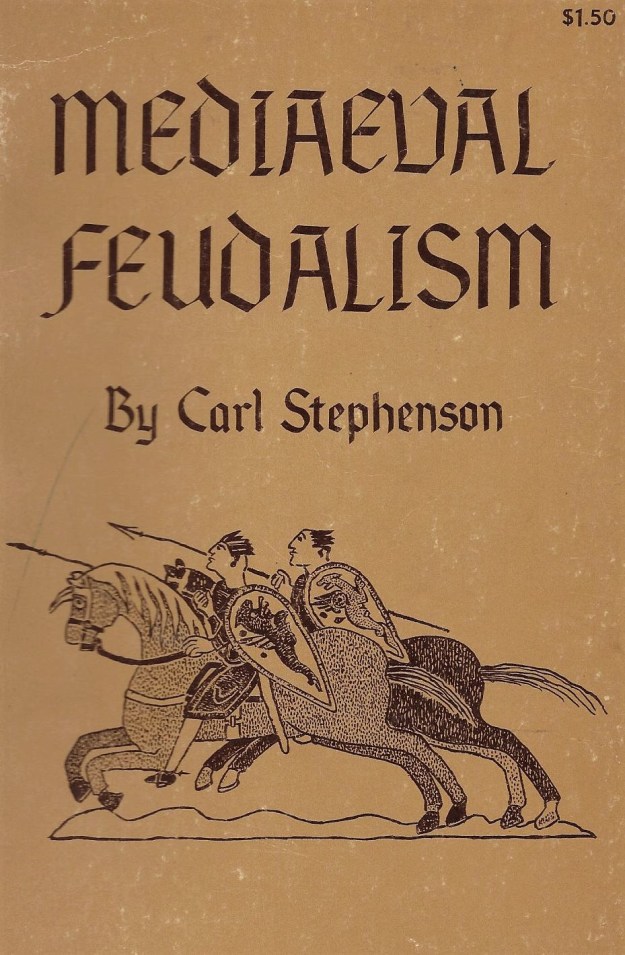
Feudalism has always fascinated me, ever since I majored in history at Brandeis University and took almost half of the courses in my major in medieval history.

The above excerpts from works I was recently reading — my interest in Sir Robert Chambers was spurred by my knowledge of his relationship with Samuel Johnson — seem to provide an excellent and succinct explanation (which I shared with my wife, who agreed) of the workings of pre-capitalist economies in Europe.

— posted by Roger W. Smith

   January 2020


Ganshof

I have kept and treasure the books from my medieval history courses.
footnotes


I have been a reader all my life and take great pleasure in it.

I am not an academic, yet I like to challenge myself by reading books on all sorts of topics. As well as trying to read the classics, I don’t shy away from reading scholarly tomes.

For example, being a lover of Walt Whitman, and always intending to read more of the writings of Ralph Waldo Emerson, I have begun reading a book by a well known English professor which discusses the influence the two had on one another.

I desire to read books in their traditional printed form, not on line. I love having the book in my hands and turning the pages. I appreciate the physical appearance of books and enjoy owing them. I tend to prefer hardbacks over paperbacks. This is especially true of hefty volumes. I find the pages easier to turn.

I have a pet peeve. It involves footnotes. Sometimes, they are boring and not essential from the reader’s point of view. But, often – usually — they are worth at least checking, and quite often, indeed, they contain valuable information. In the case of the work of some scholars, the footnotes can often be as informative as the main body of the text itself. This is true, for example, of the works of the Samuel Johnson scholar Thomas M. Curley, whose works should be better known (but never will be).

So, I ask, why are footnotes buried at the back of the book? Why do publishing practices require or mandate this?

I write scholarly essays for a separate web site of mine which is devoted to the writer Theodore Dreiser. I compose the essays using Microsoft Word. I try to document my findings using footnotes, to make what I have discovered through research verifiable and to give my articles credibility among scholars. Microsoft Word permits one to insert a footnote in a document wherever one desires. The footnote is inserted at the bottom of the page automatically, and the layout is adjusted automatically to allow space at the bottom of the page for the footnotes. One also has the option of creating an endnote, if so desired, in which case the citations appear sequentially at the end of the main body of the document.

I recall writing term papers as a college student in the 1960’s. I used a manual portable typewriter, a Royal typewriter with a Harvard College sticker on it that my older brother had bequeathed to me. Being a procrastinator, it seemed that I was always pulling “all nighters” to write the paper the night before it was due. I would have books spread out before me from which I would be cadging information for footnotes. (I almost always — by the way — composed my papers at the typewriter in a single draft, with no revisions.)

Allowing for footnotes in those days was a slight problem. One had to anticipate how many footnotes there would be at the bottom of the page, then make a pencil mark about a half an inch from the bottom of the page to allow space for each footnote. When one got to the pencil mark, one stopped typing the main text and typed in the footnote.

Can someone explain to me, if the technology is available to any student writing a term paper on his or her computer using standard word processing software — the technology to insert footnotes at the BOTTOM of EACH page, with the word processing program automatically making adjustments to allow enough space — why can’t publishing firms place footnotes at the bottom of each page instead of at the end of the book? It would save so much vexing flipping back and forth to find and read the citation. In the old days, footnotes were always at the bottom of each page in printed books. Why, in heaven’s name, do publishers insist on the supposedly “modern” way of doing it?

A friend of mine from the past who was a homegrown philosopher used to say to me, “Science marches backwards.” So do many other areas of modern life, big and small.


— Roger W. Smith

   March 2017


************************************************************

Addendum:

I had a discussion the other day about the subject of this post — namely, footnotes — with someone whose opinions I respect. He suggested to me that the reason that footnotes get buried in, relegated to, the back of the book is because publishers and authors fear that most people don’t care to read them and that, if they were placed at the bottom of the page to which they refer, many readers would find them to be a distraction.

This is undoubtedly true. True as an observation about publishing practices, that is. But, I would say, flat out wrong.

A similar point was made to me once by an eminent scholar whom I became acquainted with when I was employed at Columbia University. His books were a pleasure to read on account both of the clarity of expression and the prodigious original research that underlay them. The footnotes were copious and lengthy and demonstrated considerable industry and erudition.

In discussing a recently published book of his with the author, whom I told that I admired it, his footnotes came up. He told me he had placed them at the end because, that way, people who didn’t want to read them could ignore them.

In retrospect, I thoroughly disagree with my acquaintance’s position on this. If the reader isn’t interested, he or she can go on to the next page and ignore the footnotes.