Sarah Huckabee Sanders, in a press conference on November 17, 2017, asked about why President Trump tweeted ridiculing and criticizing Al “Frankenstein”
(but had no comment about Roy Moore)
was asked to elaborate on this in view of the fact that more than a dozen women have accused Trump of groping.
Sanders: “Senator Franken has admitted wrongdoing and the president hasn’t. I think that’s a very clear distinction.”
Sound reasoning?
What would Socrates say? … I. F. Stone (a worshipper of Socrates)?
Where did Sanders go to school? What was her major?
Addendum: Press Secretary Sanders, asked in December to comment re allegations by women that Donald Trump made inappropriate, unwanted sexual advances over the years, to wit:
such charges were made before the 2016 election; Trump denied them
Trump was elected … ergo: the American people believed the charges were false
Trump denies the charges; therefore, they are false
(Donald Trump is a man. Trump is mortal. Therefore, all men are mortal. … Don’t ask me to get this syllogism straight.)
The Metropolitan Transportation Authority is replacing the phrase “ladies and gentlemen” in announcements with gender-neutral words in an effort to be more inclusive.
It’s just one of the changes to the conductors’ script that started earlier this month.
… This morning you may hear the train conductor say something like: “Good morning, riders.”
— “New York Today: Subway Announcements Get a Human Touch,” by Jonathan Wolfe, The New York Times, November 13, 2017
The language commissars are pernicious. Yes, pernicious. Defined as “having a harmful effect, especially in a gradual or subtle way.” They are gradually eroding and stripping of its vitality our precious English tongue.
What, in God’s name, is wrong with saying “ladies and gentlemen”? It’s a polite phrase. It needs to be replaced with something “gender-neutral”? Meaning, no words or phrases that indicate gender will henceforth be permitted?
Language is a living, breathing thing. It’s organic, just like nature. Don’t let the over the top, politically correct language czars ruin it. Not only are they totally wrong in their excessive zeal and fanaticism to eradicate words in the language as it is spoken, they are ignorant, and their stupidity is dangerous.
George Orwell was prescient in inventing a language, Newspeak, in his novel Nineteen Eighty-Four, that would replace English, getting rid of supposedly superfluous words, so that a word such as bad would be replaced with “ungood.”
I can just see it, an announcement or sign on the subway or in a subway station: “Be careful with perambulators carrying passengers under age five to avoid the possibility of their getting caught in an escalator or being too close to the edge of a subway platform.”
I thought baby was a gender-neutral world, but perhaps it will someday be deemed politically incorrect and will have to be replaced by an alternative such as “parentally supervised minor.”
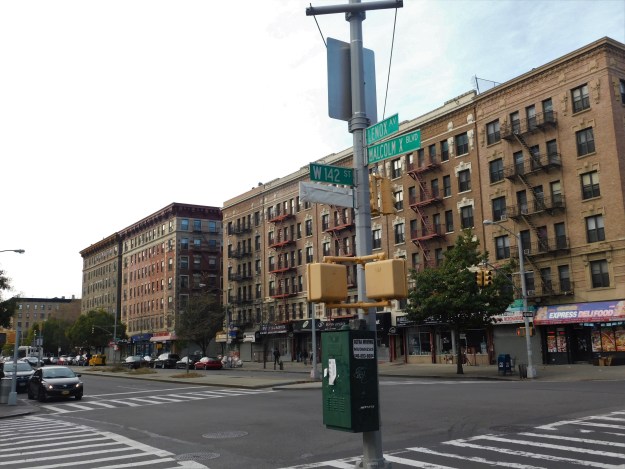
Yesterday, Sunday, November 12, I set out from my house, intending to walk the whole perimeter of Manhattan. It is a walk of around 32 miles and is said to take 12 to 15 hours. I started from 63rd Street and Second Avenue at around 7:30 a.m.
I didn’t make it. I stopped a couple of times for coffee breaks. This extended the length of my walk. By late afternoon, as darkness was coming on, I had only gotten about halfway. I was also getting tired. I would guess that I did around half the distance, a bit less. Maybe 13 or 14 miles.
If I had kept going, I would not have gotten back to my starting point, 63rd Street and Second Avenue, until probably around midnight.
Below are some photos from my jaunt.
— Roger W. Smith
November 13, 2017
Addendum: I have commented in several posts about what I perceive to be the beneficial health effects of walking. Yesterday was a very nice day, cold but clear and sunny. I had been feeling under the weather. For me, the best medicine for a cold is exercise and, especially, fresh air.
As one progresses along First Avenue, one eventually runs into a roadblock of sorts. Not an actual roadblock, but at around 125th Street, the Harlem River impedes one’s northerly progress. One has to start veering west following the curvature of Manhattan Island. One proceeds northerly through Harlem, continually veering west.
The area of First Avenue (and avenues slightly to the west) from around 90th Street to 125th Street is very bleak. There are hardly any restaurants, business establishments, or places of interest. The occasional gas station (a rarity in most of Manhattan).
One might expect such an area to become gradually gentrified, as the rest of the City has. What seems to prevent this are the bleak housing projects, built during the 1950’s in the “slum clearance” era when the poor and minorities were as a matter of policy moved to Soviet style housing projects favored by misguided (to put it kindly) city planners. These housing blocks have no personality and are grim architecturally. There are no commercial establishments nearby.
Harlem proper, which is to say the blocks in the part of Harlem further west, is a very nice area; it is becoming (and already has become, for the most part) gentrified.
Around 155th Street as I kept veering west, I took what I thought was a through street and ended up in a cul-de-sac. I realized I was in the midst of housing project. It turned out to be the Polo Grounds Towers, site of the home of the former New York Giants baseball team. The Polo Grounds stadium, home of the Giants, was demolished in 1964.
As I emerged from the housing project, I walked up a long, very steep stairway on which were painted the following words: “The John T. Brush Stairway Presented by the New York Giants.” John T. Brush (1845-1912) was one of the first owners of the New York Giants baseball team.
At the top of the stairway was Edgecombe Avenue. There was no traffic and not a pedestrian in sight. Across the street was a promontory which, though I had never been in this area before, I realized had to be Coogan’s Bluff. As noted in a Wikipedia entry, “A deep escarpment descends 175 feet from Edgecombe Avenue to the river, creating a sheltered area between the bluff and river known as Coogan’s Hollow. For 83 years, the hollow was home to the legendary Polo Grounds sports stadium.” Sportswriter Red Smith called Bobby Thomson’s homerun to clinch the 1951 pennant for the New York Giants “the miracle of Coogan’s Bluff.”
Last night, Friday, November 10, I attended a concert at Carnegie Hall in New York which included a performance of Saint-Saëns’s string quartet No. 1 in E Minor.
In the program notes, it was noted that Saint-Saëns was “an aesthetic conservative [who] railed against the stylistic innovations of Debussy and Les Six.” Les Six were a group of French composers that included Georges Auric, Louis Durey, Arthur Honegger, Darius Milhaud, Francis Poulenc, and Germaine Tailleferre.
The concert also included a performance of Brahms’s stupendous String Quartet No. 1 in C Minor, Op. 51, No. 1. A contemporary of Saint-Saëns (who outlived Brahms by a half a century), Brahms was considered a conservative within the romantic tradition.
That I like these two composers so much and am not crazy about the music of composers such as Debussy and Ravel (who Saint-Saëns also did not have a taste for) — for the most part (I am unfamiliar with the composers of Les Six) — makes me, no doubt, easily identifiable as having conservative tastes.
Yet, so many of the composers (and writers) whom I admire were profoundly original. This includes Beethoven and, yes, Shakespeare, to take in two spheres of the creative arts. I suspect that few would engage in dispute upon this. Many artists now ensconced in the canon were once regarded as being so original if not mystifying and transgressive that their works were often ignored or ridiculed.
Another thought occurred to me as a result of what the program notes said about Saint-Saëns: “Progress” in the arts, the new and avant-garde, is not always better. A distinction should be made between works that were “revolutionary” in their time and, also, indisputably great and many iconoclastic works that were perhaps intended to titillate or shock that will probably not stand the test of time. Take the visual arts for example. The Museum of Modern Art and the Whitney Museum in New York City are chock full of works that illustrate this. And consider the many writers who seem to illustrate this: Céline, Kerouac, William S. Burroughs, to name just a few.
The dustbin of the arts awaits.
Creative geniuses are emerging all the time. Whose work is revolutionary and profoundly original. I would cite examples such as Alban Berg and Philip Glass in music, Thomas Wolfe and William Faulkner in fiction, and Hart Crane and Wallace Stevens in poetry.
Addendum: My good friend Bill Dalzell, an original thinker skeptical of much of what is considered orthodoxy, used to say, “Science marches backward.” A paradox. Meaning that, while it might seem absurd, there is an element of truth in it. Perhaps the arts don’t always march forward.
On Monday, November 6, 2017, I attended a performance of A German Requiem, to Words of the Holy Scriptures (“Ein deutsches Requiem, nach Worten der heiligen Schrift”) by Johannes Brahms at Carnegie Hall in New York. The work was composed between 1865 and 1868 and consists of seven movements. The work is, as noted in a Wikipedia entry, “sacred but non-liturgical,” which can be seen in the fact that it is not in Latin and is not based on the Latin mass.
The program notes state:
Unlike the traditional Requiem, a prayer for the dead, Ein deutsches Requiem speaks to the mourners, comforting them and reminding them that the inevitability of death makes it a part of life. … Bypassing the traditional prayers for the dead, Brahms selected his text from the German Lutheran Bible and the Apocrypha. In so doing, he expressed his own feelings toward death, which were not governed by a formal sense of religion. Ein deutsches Requiem focuses on the needs of the living — Brahms had considered calling it a “human” requiem — on the brevity of life and the expectation of “evige Freude,” eternal joy.
This brought to mind other famous requiems, namely Mozart’s and Berlioz’s requiems. Both use the traditional liturgy and, what is most notable, both are masses for the DEAD. They are solemn, mournful — without, I would say, a hint of joy, and, in the case of the Berlioz requiem (which is a masterpiece), I would say, scary, almost terrifying.
I could not help thinking also about the parallels with Walt Whitman and his views of death. Below are some excerpts from the text of the Brahms requiem and some observations about Whitman’s views on death and excerpts from his poems.
Selig sind, die da Leid tragen, denn sie sollen getröstet werden. (Blessed are they that mourn; for they shall be comforted.) – Matthew 5:4
Die mit Tränen säen, werden mit Freuden ernten. Sie gehen hin und weinen und tragen edlen Samen, und kommen mit Freuden und bringen ihre Garben. (They that sow in tears shall reap in joy. He that goeth forth and weepeth, bearing precious seed, shall doubtless come again with rejoicing, bringing his sheaves with him.) – Psalm 126:5,6
Denn alles Fleisch ist wie Gras und alle Herrlichkeit des Menschen wie des Grases Blumen. Das Gras ist verdorret und die Blume abgefallen. (For all flesh is as grass, and all the glory of man as the flower of grass. The grass withereth, and the flower thereof falleth away.) – 1 Peter 1:24
Ihr habt nun Traurigkeit; aber ich will euch wieder sehen und euer Herz soll sich freuen und eure Freude soll neimand von euch nehmen. (And ye now therefore have sorrow; but I will see you again, and your heart shall rejoice, and your joy no man taketh from you.) – John 16:22
Ich will euch trösten, wie Einen seine Mutter tröstet. (As one whom his mother comforteth, so will I comfort you.) – Isaiah 66:13
Siehe, ich sage euch ein Geheimnis: Wir werden nicht alle entschlafen, wir werden aber alle verwandelt werden; und dasselbige plötzlich, in einem Augenblick, zu der Zeit der letzten Posaune. Denn es wird die Posaune schallen, und die Toten wervandelt werden. Dann wird erfüllet werden das Wort, das geschrieben steht: Der Tod is verschlungen in den Sieg. Tod, wo ist dein Stachel? Hölle, wo ist dein Sieg? (Behold, I shew you a mystery; We shall not all sleep, but we shall all be changed. In a moment, in the twinkling of an eye, at the last trump: for the trumpet shall sound, and the dead shall be raised incorruptible, and we shall be changed … then shall be brought to pass the saying that is written, Death is swallowed up in victory. O death, where is they sting? O grave, where is they victory?) – 1 Corinthians 15:51, 52, 54, 55
Walt Whitman is a great poet of the joys of life, but he is equally a great poet of death. Few poets have been immersed in the mystery of death or lived so close to death as he did. Fewer still have treated death with such an eloquent voice or created such an awesome persona. Death is a major component of the richness and variety of Leaves of Grass. …. Whitman’s poetry illustrates the universal truth that death is not only the most overwhelming and the least understood event of our existence but also the most intriguing. He realized from the outset of his poetic career that if his poetry were to reflect the essence and scope of our life experiences — and those of his own life — it must speak of death openly, imaginatively, and unswayed by clichés or established doctrines. He became a sensitive student of death and dying, familiar with disease, anguish, violence, and the displays of both fear and courage among the many dying persons he observed.
“Death is a vital part of [Whitman’s]s gospel of universal brotherhood and sisterhood, of his luminous vision of the progressive unfolding of the human race … and of his profound spirituality. And it is a vital element in the yearning for love that permeates the poems. … He viewed death as an eternal and benign mystery. … At times his poems treat death gladly, as if to embrace it; at times they treat it quizzically.
Throughout Leaves of Grass he proclaimed his faith that death was not a plunge into the terminal nada and was convinced that we can live our life fully only if we are prepared to welcome death as a transition in a continued, but still mysterious, process of spiritual evolution. Underlying this conviction was his belief that death promises some kind of future continuity for everyone—and particularly for himself. And, as the poems reveal, this belief did not come easily but was part of a trying personal and ideological struggle. Moreover, he felt that a profound respect for death was fundamental to his aesthetic and to all great art. … [Whitman’s] “Song of Myself” contains some of the most affecting death scenes in all poetry. — Harold Aspiz, So Long! Walt Whitman’s Poetry of Death (The University of Alabama Press, 2004)
Whitman had an intimate acquaintance of death as a volunteer nurse in Civil War hospitals. — Roger W. Smith
From the beginning Whitman seems to have recognized his ability to comfort the ailing immigrants and later the hospitalized horse-car drivers and injured firemen and soldiers by speaking with them in the humble manner that characterized his — and their — humble origins and by entering into their mode of thinking. — Harold Aspiz, So Long! Walt Whitman’s Poetry of Death
The grave—the grave—what foolish man calls it a dreadful place? It is a kind friend, whose arms shall compass us round about, and while we lay our heads upon his bosom, no care, temptation, nor corroding passion shall have power to disturb us. Then the weary spirit shall no more be weary; the aching head and aching heart will be strangers to pain; and the soul that has fretted and sorrowed away its little life on earth will sorrow not any more.
I do not dread the grave. There is many a time when I could lay down, and pass my immortal part through the valley of the shadow, as composedly as I quaff water after a tiresome walk. For what is there of terror in taking our rest? What is there here below to draw us with such fondness? Life is the running of a race—a most weary race, sometimes. Shall we fear the goal, merely because it is shrouded in a cloud?
– “The Tomb-Blossoms,” The United States Magazine and Democratic Review, January 1842
I wish I could translate the hints about the dead young men and women,
And the hints about old men and mothers, and the offspring taken soon out of their laps.
What do you think has become of the young and old men?
And what do you think has become of the women and children?
They are alive and well somewhere,
The smallest sprout shows there is really no death,
And if ever there was it led forward life, and does not wait at the end to arrest it,
And ceas’d the moment life appear’d.
All goes onward and outward, nothing collapses,
And to die is different from what any one supposed, and luckier.
— Leaves of Grass
I know I am deathless,
I know this orbit of mine cannot be swept by a carpenter’s
compass,
I know I shall not pass like a child’s carlacue cut with a burnt stick at night.
— Leaves of Grass
[A carlacue (variant of curlicue) is a fancifully curved or spiral figure.]
I bequeath myself to the dirt to grow from the grass I love,
If you want me again, look for me under your boot-soles.
You will hardly know who I am, or what I mean,
But I shall be good health to you nevertheless,
And filter and fibre your blood.
Failing to fetch me at first, keep encouraged,
Missing me one place, search another,
I stop somewhere waiting for you.
— Leaves of Grass
If all came but to ashes of dung,
If maggots and rats ended us, then Alarum! for we are betray’d,
Then indeed suspicion of death.
Do you suspect death? if I were to suspect death I should die now,
Do you think I could walk pleasantly and well-suited toward annihilation?
— Leaves of Grass
Great is Death—sure as Life holds all parts together, Death holds all parts together,
Death has just as much purport as Life has,
Do you enjoy what Life confers? you shall enjoy what Death confers,
I do not understand the realities of Death, but I know they are great,
I do not understand the least reality of Life—how then can I understand the realities of Death?
— Leaves of Grass
I do not know what follows the death of my body,
But I know well that whatever it is, it is best for me,
And I know well that what is really Me shall live just as much as before.
— Leaves of Grass
O the beautiful touch of Death, soothing and benumbing a few moments, for reasons;
O that of myself, discharging my excrementitious body, to be burned, or rendered to powder, or buried,
My real body doubtless left to me for other spheres,
My voided body, nothing more to me, returning to the purifications, further offices, eternal uses of the earth.
— Leaves of Grass
Whereto answering, the sea,
Delaying not, hurrying not,
Whisper’d me through the night, and very plainly before day-break,
Lisp’d to me the low and delicious [italic added] word death,
And again death, death, death, death,
Hissing melodious, neither like the bird nor like my arous’d child’s heart,
But edging near as privately for me rustling at my feet,
Creeping thence steadily up to my ears and laving me softly all over,
Death, death, death, death, death.
— “Out of the Cradle Endlessly Rocking.”
And if the memorials of the dead were put up indifferently everywhere, even in the room where I
eat or sleep, I should be satisfied,
And if the corpse of any one I love, or if my own corpse, be duly rendered to powder, and poured
in the sea, I shall be satisfied,
Or if it be distributed to the winds, I shall be satisfied.
— Leaves of Grass
Death is beautiful from you, (what indeed is finally beautiful except death and love?)
O I think it is not for life I am chanting here my chant of lovers, I think it must be for death,
For how calm, how solemn it grows to ascend to the atmosphere of lovers,
Death or life I am then indifferent, my soul declines to prefer,
(I am not sure but the high soul of lovers welcomes death most,)
Indeed O death, I think now these leaves mean precisely the same as you mean.
— Leaves of Grass
My dead absorb or South or North—my young men’s bodies absorb, and their precious precious blood,
Which holding in trust for me faithfully back again give me many a year hence,
In unseen essence and odor of surface and grass, centuries hence,
In blowing airs from the fields back again give me my darlings, give my immortal heroes,
Exhale me them centuries hence, breathe me their breath, let not an atom be lost,
O years and graves! O air and soil! O my dead, an aroma sweet!
Exhale them perennial sweet death, years, centuries hence.
— Leaves of Grass
I saw battle-corpses, myriads of them,
And the white skeletons of young men, I saw them,
I saw the debris and debris of all the slain soldiers of the war,
But I saw they were not as was thought,
They themselves were fully at rest, they suffer’d not,
The living remain’d and suffer’d, the mother suffer’d,
And the wife and the child and the musing comrade suffer’d,
And the armies that remain’d suffer’d.
– “When Lilacs Last in the Dooryard Bloom’d”
I make a scene, a song, brief (not fear of thee,
Nor gloom’s ravines, nor bleak, nor dark—for I do not fear thee,
Nor celebrate the struggle, or contortion, or hard-tied knot),
Of the broad blessed light and perfect air, with meadows, rippling tides, and trees
and flowers and grass,
And the low hum of living breeze—and in the midst God’s beautiful eternal right hand,
Thee, holiest minister of Heaven—thee, envoy, usherer, guide at last of all,
Rich, florid, loosener of the stricture-knot call’d life,
Sweet, peaceful, welcome Death.
“Death’s Valley” (published in Harper’s Monthly Magazine, April 1892):
Selig sind, die da Leid tragen (Blessed are they who bear suffering)
the opening of Ein deutsches Requiem
Denn alles Fleisch, es ist wie Gras (For all flesh, it is as grass)
the second movement of Ein deutsches Requiem
This extraordinarily powerful, lyrical movement never fails to move me. I had long thought that the lyrics must mean something like: Let’s face it, everyone is going to die; death and decay are inevitable. But the words from scripture are actually consoling:
Denn alles Fleisch ist wie Gras und alle Herrlichkeit des Menschen wie des Grases Blumen. Das Gras ist verdorret und die Blume abgefallen.
So seid nun geduldig, lieben Brüder, bis auf die Zukunft des Herrn. Siehe, ein Ackermann wartet auf die köstliche Frucht der Erde und is geduldig darüber, bis er empfahe den Morgenregen und Abendregen.
Aber des Herrn Wort bleibet in Ewigkeit.
Die Erlöseten des Herrn werden wieder kommen, und gen Zion kommen mit Jauchzen; ewige Freude wird über ihrem Haupte sein; Freude und Wonne werden sie ergreifen und Schmerz und Seufzen wird weg müssen.
(For all flesh is as grass, and all the glory of man as the flower of grass. The grass withereth, and the flower thereof falleth away.
Be patient therefore, brethren, unto the coming of the Lord. Behold, the husbandmen waiteth for the precious fruit of the earth, and hath long patience for it, until he receive the early and latter rain.
But the word of the Lord endureth for ever.
Those whom the Lord delivers shall return, and come to Zion with songs and everlasting joy upon their heads: they shall obtain joy and gladness, and sorrow and sighing shall flee away.)
The music perfectly matches these sentiments.
Introitus
from Mozart, Requiem in D minor, K. 626
Requiem aeternam and Kyrie
from Berlioz, Grande Messe des morts (or Requiem), Op. 5
Pie Jesu
from Gabriel Fauré, Requiem in D minor, Op. 48
The focus of this “choral-orchestral setting of the shortened Catholic Mass for the Dead in Latin … is on eternal rest and consolation. … Fauré wrote of the work, ‘Everything I managed to entertain by way of religious illusion I put into my Requiem, which moreover is dominated from beginning to end by a very human feeling of faith in eternal rest.’ … He told an interviewer: ‘It has been said that my Requiem does not express the fear of death and someone has called it a lullaby of death. But it is thus that I see death: as a happy deliverance, an aspiration towards happiness above, rather than as a painful experience.’ (Wikipedia)
“Every soul has its own individual language, often unspoken, or lamely feebly haltingly spoken; but a true fit for that man, and perfectly adapted to his use.—The truths I tell to you or any other may not be plain to you, because I do not translate them fully from my idiom into yours.—If I could do so, and do it well, they would be as apparent to you as they are to me; for they are truths.—No two have exactly the same language, and the great translator and joiner of the whole is the poet, He has the divine grammar of all tongues, and says indifferently and alike How are you friend? to the President in the midst of his cabinet, and Good day my brother, to Sambo, among the hoes of the sugar field and both understand him and know that his speech is right.—”
— Walt Whitman, Notebooks and Unpublished Prose Manuscripts (New York University Press, 1984), vol. 1, pp. 60-61
This is characteristic Whitmanesque language. So bracing. So original. So simple and straightforward. Utterly sincere and spontaneous. Utterly unaffected. It feels like language made anew in the workshop of the consciousness. It is almost childlike in its simplicity yet profound in its implications. If feels as if not only were a new poetic language and grammar being invented, but as if the world were being seen anew with fresh eyes. Yet, not pompously from on high, but from the level of a friend of yours or mine — of the president or a slave — who can be so greeted without ceremony.
But she had an early morning engagement today, and I was planning to leave the house early.
I went to our local Dunkin‘ Donuts to get two coffees to go.
The line was moving too slowly for me. I felt inpatient.
Then I realized what was holding it up.
Two kids were in front of me, obviously brother and sister on their way to school. They were clearly minority group kids. My neighborhood is mostly minority.
They were endearing. The boy, who was stocky and had spiky jet black hair, was about eight, his sister about six.
Once I realized the reason for the holdup, I became pleasantly amused.
The boy had a few bills in his hand. They were asking how much a doughnut cost, what was the price of a chocolate or a glazed doughnut versus a sprinkled one, and so forth.
The boy kept checking to make sure he had enough money. For both him and his sister. He was the responsible party.
The young woman behind the counter was very patient with them.
Why are such little vignettes, such tableaux, so emotionally satisfying and fortifying, so uplifting?
Because they remind us what really counts in life. And to stop and notice.
Did you ever have an experience in the course of life, at a particular moment on a particular day — something seemingly inconsequential — that permanently altered your fundamental outlook on life?
This happened to me once.
It is funny how such moments of extraordinary perception and insight come about.
The sudden realization I had was something obvious which could be expressed as follows: The world doesn’t revolve around me.
Of course, I already knew that. I was not that self-centered. But, the epiphany inducing incident, which occurred when I was in middle age, blew away the last vestiges of adolescent style self-absorption.
I had just completed graduate school and was hired by a consulting firm as a technical writer. I was about to begin my first day of work.
The head of my department, Jack Barrett, called me to finalize arrangements. I asked if I could report on March 15, which was a couple of days away. Would that be all right?
“Certainly,” he said.
I was looking forward to the new position, but at the same time I was kind of rueful because I had been getting, all of a sudden, some very interesting freelance writing assignments of which I was proud. I said to Barrett: “Today, I will be working on the City Desk at Newsday. I have been asked to work there a lot lately.” Something like that.
“Hmm,” he said, and quickly moved on to discussing a couple of details of my employment. He could have cared less about the freelance work I was doing. He was a busy man running a department. He had called me merely to finalize arrangements. We had already discussed my qualifications and accomplishments in the interview, based upon which I had been hired. That was a fait accompli.
Why should I have thought he would be interested in the details of my freelance work, I saw, to my chagrin.
It hit me square in the face: Most people are engrossed in their own responsibilities and daily activities. They don’t have time to focus on mine, nor would they be likely to be all that interested. Perhaps my wife would. But that’s different. One should not assume that people one meets in public, so to speak, are that interested in or focused upon you. When interacting with them, one should always keep in mind: it’s about THEIR priorities, not yours. For the moment, that is. Or, to put it another way (awkwardly), in the present actuality. This does not mean self-abnegation is required. It’s simply a matter of always keeping the thought uppermost in one’s mind: what is the other person likely to be thinking? where are they coming from? what do they need or require?
My father told me a story once which, I think, illustrates the same point, though perhaps not obviously. He said that as a young man he had a tendency to try to impress people. Once, he said, he was at a party and somebody or other was talking about a new model car that was supposed to be THE car to own, a vehicle one would be proud to be seen driving. My father put his two cents worth in and started talking about that car and how great it was, and how he knew all about it. The man who had introduced the car as a topic of conservation looked askance at my father and said, “You own one?”
“No, I don’t,” my father had to admit.
My Dad said that the realization came upon him that he was always talking as if he were entitled to be an authority on this or that — to weigh in — or that he was in on something, to impress people. The other man’s comment made him see this, to his chagrin, but for him it was a valuable lesson.
People are preoccupied with themselves and their concerns, whatever they are doing and thinking about at the moment; what concerns them; what they are or must be dealing with. I am of scant interest to them and if one manages to engage another’s interest, it is only transitory.
I was talking on the phone today with my longtime friend from my first days in New York, Bill Dalzell. He told me something that his dear friend Edwin Treitler once said to him. Ed Treitler, who recently passed away, was an artist, writer, and spiritual counselor/healer.
The quote, which struck me forcibly and rung true, was short and pithy: “I went to the school of New York.”
The school of New York. Herman Melville would have perceived instantly what this meant.
It rings so true when I consider my own experience.
I had a very good education, for which I am very grateful. Then, I went further.
I moved to New York City right after graduating from college, and my education really began. Or was on a new plane. Something like that.
I had never seen a really good film. Had never, I believe, patronized an art film house. Had often frequented bookstores, but had never seen so many used bookstores cheek by jowl with so many interesting books, including many by avant-garde writers who were usually not taught in college.
I had never read so intensely and deeply before in such weighty works. I had never met such intellectually stimulating people. Many of them, most of them, I met in totally offhanded and unanticipated ways, in places where you would not expect to find someone smart and interesting, often in the workplace. It reminded me of Theodore Dreiser’s friends in his early Chicago days; (recounted in his autobiography Dawn).
I met many such persons in my early days in Manhattan: a poet who it seemed had read the whole corpus of great poetry — and knew all those currently active, including the New York School of poets (and who took me with him to poetry readings in Manhattan) — and practically every important work of literature from time immemorial, ranging from Roman poets such as Juvenal and Sextus Propertius to the most recent and challenging fiction by writers such as Thomas Pynchon … a printer who was thoroughly immersed in mysticism and the visual arts (and whom I tagged along with to the Metropolitan Museum of Art and the Whitney; from him I became acquainted with painters such as Edward Hopper, whom I had never heard of) … and so many people whose ideas piqued me and who submerged me in new areas of thought and “mental adventure” and who introduced me to books, painters exhibited in the City’s museums and galleries, filmmakers, and such that I would probably never have learned about.
The true intellectuals, I find, are often buried in the woodwork, are in the back office or hunkered down over a desk doing drudge clerical work (as was I).
I had such stimulating conversations with people I met at random in taverns and at work, or with their friends. Almost none of them were well off, and most were at a stage in their lives where they were starting out and did not have impressive credentials, or were perhaps older but had never become credentialed. They were barely making it. But they had a deep passion for ideas, the arts, and culture.
I instinctively took to such a milieu as a duck to water. I bathed in it, drank of it. I grew immeasurably intellectually. I became sophisticated culturally and intellectually. I became a hundred percent better informed, better read, better educated.
It has been said that New York is like no other city in the world. For me, this was true. There is an openness to ideas there, a wonderful tolerance, an acceptance of people without any expectation that one must conform. Loners are accepted. (I was afraid I might be perceived as a loner when I first came to New York knowing no one.) Eccentrics are accepted. People of all ideologies and belief systems are accepted, and of all backgrounds. Stimulating conversation by highly aware, well informed, intellectually alive, and intelligent people is the norm.
Cultural sophistication comes with the territory. The arts are almost upon you, so to speak, are omnipresent. It’s almost impossible to be in New York and not to be aware of them and influenced, liberated, and exhilarated by them. New York broadens you, stimulates you, educates you anew. And keeps right on stimulating and educating you.
So true. I was walking around the City the day before yesterday and had just this feeling. With the exception of a very few neighborhoods, one being Times Square, one can amble about the City and feel that one is in a cozy neighborhood where all are welcome, everything is accessible to you, business establishments are inviting and customer friendly, and people are laid back. (Besides being friendly; one wouldn’t expect this in a big city which is supposed to be cold and impersonal and full of Sammy Glick types, but it’s true.)
I was on Amsterdam Avenue in the West 70’s; it was a sunny day. People were strolling about leisurely or chatting in local pubs and restaurants. There was an undeniable air of tranquility and an unhurried pace which seemed to prevail. I made my way down Broadway to Columbus Circle and then to Carnegie Hall at 57th Street and Seventh Avenue and stood there, first talking to a friend on a cell phone and then studying the advertisements for upcoming concerts as strollers passed by. One would have thought one was on Main Street in Smallville, USA.