Monthly Archives: September 2020

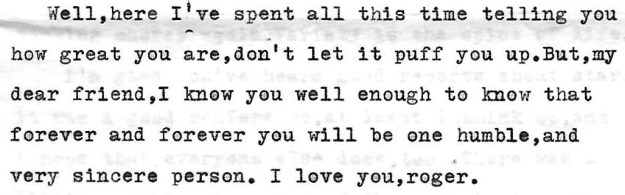
“I … know that …”


Above is an excerpt (the peroration) from a letter I received from a friend, Kathy Phair of Harvard, Massachusetts, in July 1964. At the time of the letter, Kathy was working at a Girl Scout camp in Harvard, and I had a summer job on Cape Cod.

Kathy may have been in love with me, but I never realized this, if it were true. She was, when we first met, the girlfriend of a good friend of mine. We (she and her boyfriend Tom) used to do things together as a threesome. We had some wonderful times.


*****************************************************

Why post this quote? Some will say it is narcissism, egotism, on my part.

Undoubtedly some of my spiteful relatives will.

I am posting it because I know that, for a fact, I haven’t changed, as my wife and some of my close friends realize. The part about being “one humble, and very sincere person” meant and still means a lot to me.

The last time I saw Kathy was in my early twenties. She came to visit me where I was living then, near Boston. We went together to a poetry reading by the poet L. E. Sissman in Kathy’s hometown, Harvard.

Kathy died shortly afterward (at which time she was married) from an illness of long duration which had begun at an early age. She never complained about it.


— Roger W. Smith

   September 2020

prosateur (prose writer)


prosateur

A French word meaning prose writer.

We have no equivalent word. I ran across it this evening in a quote from Sartre.

Prosateur. Something I aspire to. (It’s good to have ideals. What famous writer said this?)


— Roger W. Smith

   September 9, 2020


the bloviator


bloviate

to talk at length, especially in an inflated or empty way


*****************************************************

Real speech comes, on average, in packets of 10 or so words at a time, rather sloppily juxtaposed. Rapid, spontaneous talk makes more use of parataxis — the stringing of simple clauses together, such as in this segment:

Look, having nuclear — my uncle was a great professor and scientist and engineer, Dr. John Trump at M.I.T.; good genes, very good genes, O.K., very smart, the Wharton School of finance, very good, very smart — you know, if you’re a conservative Republican, if I were a liberal, if, like, okay, if I ran as a liberal Democrat, they would say I’m one of the smartest people anywhere in the world – it’s true! – but when you’re a conservative Republican they try – oh, they do a number – that’s why I always start off: “Went to Wharton, was a good student, went there, went there, did this, built a fortune”– you know I have to give my life credentials all the time, because we’re a little disadvantaged – but you look at the nuclear deal, the thing that really bothers me … (speech by Republican presidential candidate Donald Trump, Sun City Hilton Head, South Carolina, July 19, 2016)

In writing, this would likely be rendered using hypotaxis, which entails clearer subordinate clauses. The same sentence would be written as: “My uncle Dr. John Trump, who was a professor at M.I.T., had very good genes, which lent him considerable intelligence.”


*****************************************************

Donald Trump, press conference, September 7, 2020:

The story is a hoax, written by a guy who has got a tremendously bad history. The magazine itself — which I don’t read, but I hear it’s just totally anti-Trump; he’s a big Obama person, he’s a big Clinton person. And he made up the story. It’s a totally made-up story.

In fact, I was very happy to see Zach Fuentes came out and said now he’s — that’s — I think that’s number 15 — and these are people that were there. That’s the 15th person. General Kellogg, everybody that was there knew what happened. And so I was happy to see that Zach came out and said it’s not true. He just came out.

And it’s a disgrace. Who would say a thing like that? Only an animal would say a thing like that. There is nobody that has more respect for not only our military, but for people that gave their lives in the military. There’s nobody — and I think John Kelly knows that. I think he would know that. I think he knows that from me.

But Zach Fuentes, as you know, worked for John. And I think they both know that. But Zach came out, as you know, today or yesterday, last night, and said very strongly that he didn’t hear anything like that. Even John Bolton came out and said that was untrue.

Now, what was true is that we had the worst weather. I think it was as bad a rain as I’ve just about ever seen. And it was a fog you — you literally couldn’t see. I walked out, and I didn’t have — I didn’t need somebody to tell me. I walked out and I said, “There’s no way we can take helicopters in this.” I understand helicopters very well. And they said, “No, sir, that’s been cancelled.”

They would have had to go — Secret Service, I have the whole list — they would have had through a very, very busy section, during the day, of Paris. They would have had to go through the city. The Paris police were asking us, “Please don’t do it,” because they’re not ready. When you do that, you need a lot of time. They take days and days and days to prepare for that.

I wanted to do it very badly. I was willing to sit in the car for two hours, three hours, four hours. I didn’t care. It didn’t matter. And I had nothing else to do. I went there for that; I had nothing else to do. It was ended because of the terrible weather, and nobody was prepared to go through, in terms of Paris, the police, the military, and the Secret Service. And they came out very strongly and said, “Sir, we can’t allow you to make this trip.” If I wanted to: “Sir, we can’t allow you, from a safety standpoint.”

It was a phony story, just like the dirty dossier — the fake, dirty dossier; just like the Russia collusion; just like all of the other phony stories. And there’ll be more phony stories.

But I do appreciate Zach coming out. But Zach now is the 15th person that’s denied it. Zach now, I think, also talked about the weather aspect of it. And he’s probably the 14th or 15th person that blamed it on weather. So that’s enough of that.


— posted by Roger W. Smith

   September 8, 2020

Monteverdi, “Deposuit potentes” (He hath put down the mighty)


The first track is from the soundtrack to the French director Robert Bresson’s film Mouchette (1967). Viewing this film, at the long gone Elgin Theater on Eighth Avenue in Chelsea, I first became aware of Monteverdi. A similar thing has happened to me with literature, for example: when I first read a few paragraphs from The Private Papers of Henry Ryecroft by George Gissing, an author I had barley heard of, in a course at Columbia University.

The second track is from a recording of Monteverdi’s Vespers of 1610 by the Sixteen, an English choral group.

The third track is from a recording of a live performance by Tenet Vocal Artists of Monteverdi’s Vespers of 1610 which I attended in January 2020 at St. Jean Baptiste Church in New York City.

You can also view on YouTube at


Deposuit potentes de sede,
Et exaltavit humiles

He hath put down the mighty from their seats, and exalted them of low degree.

— Luke 1:52


Pathos, beauty, intense spirituality.


— posted by Roger W. Smith

   September 2020; revised March 2022

the trouble with …


Therefore, all such things as you wish men might do to you, so do to them as well: for this is the Law and the prophets.

Matthew 7:12


And just as you wish men should do to you, do likewise to them.

Luke 6:31

The New Testament: A Translation, by David Bentley Hart


No man is an Iland, intire of itselfe; every man
is a peece of the Continent, a part of the maine;
if a Clod bee washed away by the Sea, Europe
is the lesse, as well as if a Promontorie were, as
well as if a Manor of thy friends or of thine
owne were; any mans death diminishes me,
because I am involved in Mankinde;
And therefore never send to know for whom
the bell tolls; It tolls for thee.

— MEDITATION XVII, Devotions Upon Emergent Occasions, and severall steps in my Sicknes, by John Donne


No man is an island
No man stands alone
Each man’s joy is joy to me
Each man’s grief is my own

— Joan Baez, “No Man Is An Island” (lyrics)


*****************************************************

Re;

“The Trouble With Empathy: Can we really be taught to feel each other’s pain?”

By Molly Worthen

op-ed

The New York Times

September 4, 2020

‘The Trouble with Empathy’

The trouble with this 1,990-word essay is that it attempts to dissect a topic that needs no more analysis or exposition other than perhaps to state the obvious. See the quotations above. There is such a thing as cumulative or received wisdom. The wisdom of the ages.


*****************************************************

Statements from the op-ed follow, in ITALICS. My “commentary” is in ALL CAPS.


[I]n recent years, empathy — whether we can achieve it; whether it does the good we think — has become a vexed topic.

WHY? TOO BAD JESUS LACKED THE REQUISITE EMOTIONAL INTELLIGENCE TO BE ABLE TO DISCUSS IT OTHER THAN SIMPLISTICALLY.


When we attempt to step into the shoes of those very different from us, do we do more harm than good?

NO.


… skeptics say that what seems like empathy often may be another form of presumption, condescension or domination.

NOT TRUE, IF ONE IS TALKING ABOUT GENUINE EMPATHY, WHICH REQUIRES CONNECTING WITH AN OTHER (SOMEONE WHO IS NOT YOU).

OBVIOUSLY, THIS TAKES EFFORT ON THE EMPATHIZER’S PART.


If an author of European descent writes a novel from the perspective of Indigenous people, is it an empathic journey, or an imperialist incursion?

IT’S A NOVEL.


— posted by Roger W. Smith

   September 2020