Category Archives: miscellaneous; general interest

the dead-carts


I say they had dug several pits in another ground, when the distemper began to spread in our parish, and especially when the dead-carts began to go about, which was not, in our parish, till the beginning of August. Into these pits they had put perhaps fifty or sixty bodies each; then they made larger holes wherein they buried all that the cart brought in a week, which, by the middle to the end of August, came to from 200 to 400 a week; and they could not well dig them larger, because of the order of the magistrates confining them to leave no bodies within six feet of the surface; and the water coming on at about seventeen or eighteen feet, they could not well, I say, put more in one pit. But now, at the beginning of September, the plague raging in a dreadful manner, and the number of burials in our parish increasing to more than was ever buried in any parish about London of no larger extent, they ordered this dreadful gulf to be dug–for such it was, rather than a pit.

— Daniel Defoe, A Journal of the Plague Year (1722)


*****************************************************

“A refrigerated truck has been stationed outside to hold the bodies of the dead. Over the past 24 hours, New York City’s public hospital system said in a statement, 13 people at Elmhurst [Hospital Center] had died.”

— “One day, 13 deaths, and an overwhelmed city hospital.,” The New York Times, March 26, 2020


— posted by Roger W. Smith

   March 26, 2020

Schubert


In some British film that I was watching with my wife last night, there was a scene with a young woman playing the piano: Beethoven, Chopin, and another piece.

“I know that piece,” I said to my wife. Then, after a moment or two of concentration, I said, “It’s Schubert. One of his impromptus.”

Here it is. I find Schubert very appropriate for these incredibly sad times.

Also posted above is Liszt’s piano transcription of a song from Schubert’s song cycle Winterreise (Winter’s Journey): namely, “Wasserflut” (“Flood”).


— posted by Roger W. Smith

   March 22, 2020

“crisis managers”


Second Avenue 3-15-2020

Second Avenue, Sunday, March 15, 2020

I can’t speak for most people, but I assume that my behavior in response to the Coronavirus epidemic is not that uncommon.

My initial instincts a week or two ago — my thoughts then — were, I can’t eliminate all possibility of illness, control all circumstances. I will try to observe the recommend actions (such as washing my hands more frequently) and precautions, but I’m not going to shut down, or alter my daily routine.

Since then, the fears and warnings have been mounting steadily at an accelerating pace. I am taking the warnings and recommendations seriously and am planning to stay at home for the most part. And many activities such as concerts and classes have been canceled anyway.


*****************************************************

On Thursday evening during the preceding week, before language classes were cancelled, I was seated on a bench in a hallway of the language school waiting for my class to begin. I was conversing with a fellow student.

I coughed once or twice.

Being very mindful of warnings regarding coughing in public places, I leaned over, turned away from my classmate, and covered my mouth.

“Are you ill?” an obnoxious woman seated across the hall with a friend said. When I didn’t answer right away, she repeated the question.

“I coughed,” I said. “That isn’t unusual. Are you trying to imply that I have an infection?”


*****************************************************

I can’t stay indoors all the time, and I wouldn’t recommend it for healthy people, virus notwithstanding.

Yesterday I went for a walk in Manhattan. A beautiful, mild, sunny day. Sun drenched sidewalks.

I was walking downtown on Second Avenue in the 30’s.

I seem to have an allergic condition where, at any time, including times when I am well and don’t have a cold, the air can cause me to cough. It’s usually cold air, the effects of which I often experience the minute I go outside, or sometimes dust indoors.

It was approximately 1 p.m. There were very few pedestrians, and there was no one near me.

A gust of wind hit me, and I coughed once. It was barely noticeable.

I continued walking. I thought I heard someone say, angrily, “Cover your mouth!”

I walked a few more steps, then turned and looked backwards. Was the remark meant for me?

Apparently — in fact — it was. The only other people on the block were a woman and man standing together a half a block away. They were conversing, not walking.

It was the woman who had told me to cover my mouth.

The average city block in Manhattan is slightly over 260 feet long. The couple was more than 100 feet away from me when I coughed. I was in the open air when I coughed. Not near anyone. Not coughing on anyone or in their face.

*****************************************************

Panics, disasters, and emergencies bring out all kinds of reactions and behaviors in people.

Good and bad. The best and the worst. Selfish and altruistic. Noble and petty.

Some persons exhibit increased concern and thoughtfulness for others and their welfare. Others use them as an occasion to exhibit traits of officiousness and pettiness which they feel a license to exhibit.

Such as taking out their anxieties and fears and obsessive tendencies on others who have nothing to do with them and no actual or conceivable relationship to any actual emergency.

They are taking their anxiety out on others and therefore increasing the level of everyone else’s anxiety.

*****************************************************

The truth of the situation with these minders, these obnoxious persons, is that they see a crisis situation as an opportunity, almost an incentive, to pick on other people who didn’t create the situation and who have no more to do with it than they do.

There is no way to tell who one encounters in public might be infected. But let’s pick on anyone whom we don’t take to, or about whom something or other might give us the opportunity to show that we are on the lookout for infected persons. Got to keep our streets and classes disease free!

Shows we are on the watch.

We went for a walk in public despite the warnings. While we’re out, we’ll police the streets. Can’t have too few “hall monitors” watching the sidewalks for Coronavirus transmitters. We’re civic minded. No telling who might deserve a scolding.


*****************************************************

A crisis brings out the magnanimous and the petty.

Some people are inherently mean.

A crisis gives them an incentive and what they regard as license to take out their mean impulses on the pretense that it’s for the common good. They view themselves as benefactors when it’s actually the opposite. Read, malefactor(s). They are doing harm.

Dissatisfaction with themselves and present conditions becomes disapproval of others.

— Roger W. Smith

   March 16, 2020


*****************************************************

addendum:

I recommend as reading at this time an unforgettable and totally engrossing book: A Journal of the Plague Year by Daniel Defoe.

cover - A Journal of the Plague Year


“the four things that no human being can endure” (a question the answer to which was torturing me)


Roger W. Smith email to Sherwood Waldron, MD, February 20, 2017:

Dear Dr. Waldron,

I am a writer living in Queens, NYC.

I hope this query is not a nuisance.

I am trying to find the answer to a question that has been torturing me.

I was seeing a therapist, Dr. Ralph Colp, Jr., in Manhattan over a long period of time. Dr. Colp passed away in 2008.

I tend to remember practically everything Dr. Colp said, word for word. That was the value his words and observations had for me.

But, I can’t quite remember one thing he told me. We were talking about my experience of loneliness, and how I had managed to overcome it.

Dr. Colp said to me, quoting some well known psychoanalyst or writer (I think it was a psychoanalyst), that there were four (?) things that no one — no human being — can stand or endure: loneliness, anxiety (?), and _________.

I can’t recall the source of the quote. I doubt it was Freud, because I would have remembered it if this were the case. It was probably someone more recent whose works Dr. Colp was acquainted with.

I have Googled the quote to no avail. I thought it might have been Alfred Adler, Erich Fromm, or Harry Stack Sullivan.

It could have been Abraham Maslow, but I don’t recall that Dr. Colp mentioned him. It seems I would have remembered, since I knew of Maslow, who taught at Brandeis University when I was a student there. Maslow said similar things.

It could have been Erik Erikson. But, again, it seems that I would have remembered.

Others who come to mind:

Bruno Bettelheim

Rollo May

Schopenhauer

Karl Menninger

It could have been the psychotherapist Irvin D. Yalom, who wrote about “ultimate existential concerns,” namely death freedom isolation, and meaninglessness.

Would you have any idea where the quote might have come from, or how I might go about researching or inquiring about it?


*****************************************************

Sherwood Waldron MD email to Roger W. Smith, February 20, 2017

Sorry, I don’t recognize the quote.


*****************************************************

Roger W. Smith email to Sherwood Waldron MD,  January 31, 2020

Dear Dr. Waldron,

I do not expect you to reply to this email unless you wish to.

However, since you were kind enough to reply to me (almost three years ago), I now know (through my persistence) where the passage Dr. Colp was referring to came from.

It is in the works of Irvin D. Yalom, reprinted in The Yalom Reader (Basic Books, 1998), pp. 172-173. What I recalled was that there were four ultimate concerns that Dr. Colp spoke of: they are (Yalom’s four concerns) existential conditions faced by all persons that if not faced inspire dread. One of the four existential concerns is isolation (which I recalled as aloneness, which is the same thing. but I wasted a lot of time Googling using the wrong words).

I am certain that Dr. Colp was familiar with Dr. Yalom’s works — given that he often purchased books from this publisher and that he and Dr. Yalom published, at least once, articles in the same issue of the same journal, Free Associations: Psychoanalysis and Culture, Media, Groups, Politics.

Sincerely,

Roger W. Smith


*****************************************************

THE ULTIMATE CONCERNS OF HUMAN LIFE

Existential therapy is a dynamic approach to therapy which focuses on concerns that are rooted in the individual’s existence.


[T]he primary concerns are deeply buried, encrusted with layer upon layer of repression, denial, displacements, and symbolization.”

The existential position emphasizes a conflict that flows from the individual’s confrontation with the givens of existence.


This book deals with four ultimate concerns: death, freedom, isolation, and meaninglessness. The individual’s confrontation with each of these facts of life constitutes the content of the existential dynamic conflict.

Death The most obvious, the most easily apprehended ultimate concern is death. We exist now, but one day we shall cease to be. Death will come, and there is no escape from it. It is a terrible truth, and we respond to it with mortal terror. “Everything,” in Spinoza’s words, “endeavors to persist in its own being”;’ and a core existential conflict is the tension between the awareness of the inevitability of death and the wish to continue to be.

Freedom Another ultimate concern, a far less accessible one, is freedom. Ordinarily we think of freedom as an unequivocally positive concept. Throughout recorded history has not the human being yearned and striven for freedom? Yet freedom viewed from the perspective of ultimate ground is riveted to dread. In its existential sense “freedom” refers to the absence of external structure. Contrary to everyday experience, the human being does not enter (and leave) a well-structured universe that has an inherent design. Rather, the individual is entirely responsible for–that is, is the author of–his or her own world, life design, choices, and actions. “Freedom,” in this sense, has a terrifying implication: it means that beneath us there is no ground-nothing, a void, an abyss. A key existential dynamic, then, is the clash between our confrontation with groundlessness and our wish for ground and structure.

Existential Isolation A third ultimate concern is isolation-not in­terpersonal isolation with its attendant loneliness, or intrapersonal isolation (isolation from parts of oneself), but a fundamental isolation–an isolation both from creatures and from world–which cuts beneath other isolation. No matter how close each of us becomes to another, there remains a final, unbridgeable gap; each of us enters existence alone and must depart from it alone. The existential conflict is thus the tension between our awareness of our absolute isolation and our wish for contact, for protection, our wish to be part of a larger whole.

Meaninglessness A fourth ultimate concern, or given, of existence is meaninglessness. If we must die, if we constitute our own world, if each is ultimately alone in an indifferent universe, then what meaning does life have? Why do we live? How shall we live? If there is no preor­dained design for us, then each of us must construct our own meanings in life. Yet can a meaning of one’s own creation be sturdy enough to bear one’s life? This existential dynamic conflict stems from the dilemma of a meaning-seeking creature who is thrown into a universe that has no meaning.

— from Irving D. Yalom, “The Four Ultimate Concerns,” Essential Therapy; The Introduction; reprinted in The Yalom Reader (Basic Books, 1998), pp. 169-173


*****************************************************

Persistence, doggedness pay off in research.

I never give up.

My wife often says, “You can find ANYTHING.”

My former therapist, Dr. Colp, an independent scholar, used to ask me to do research for him pro bono. I used to wonder, was it his way of sort of exacting payment in kind to make up for his very low fees? Sometimes the research was very tedious. But, I told him that I was flattered to be asked.

The questions he asked me to research were never easy ones. They were minuscule things which he couldn’t find the answer to. Such as who wrote a certain poem that Charles Darwin knew of because he liked a song  composed by Sir Arthur Sullivan in which the lyrics of the poem had been set to music? It was some Victorian poet. I found the answer to that one (Adelaide Procter).

And, who was the author of a bestselling women’s novel that Darwin liked? I never did find the answer. The novel (entitled The Fair Carew) was published anonymously, and it appears that even to this day the author’s identity has never been discovered. (Dr. Colp read the novel in a library in London during a visit there.)


— posted by Roger W Smith

   March 2020

“Oh, For a Lodge in Some Warm Wilderness!” (a New Yorker’s dream)


OH, FOR A LODGE IN SOME WARM WILDERNESS!

The Cry of Many a New-Yorker Whose Business Worries are Aggravated by a Bad Cold.

New-York Tribune

February 21, 1904


Doubtless, this winter, when the North River,* overhung with mist and full of huge cakes of ice, resembled a scene on the coasts of Labrador, and the streets have seemed never to be free from snow and ice, many a New-Yorker with a cold has found the Psalmist’s words: “Oh, that I had the wings of a dove; for then I would fly away and be at rest,”** highly expressive of his feelings. Forgetting that one of the great characteristics of the human being which most widely differentiates him from other animals is his ability to adapt himself to the rigors of any climate, and that, therefore, he ought to give proof of his superiority by gloriously braving it out, he would gladly take wing and follow the birds to the warmer climates where there is no pneumonia, where the furnace troubleth not and the walks are fringed with green instead of covered with white. This winter has been more trying than previous winters for a number of years. The constantly recurring snowstorms and cold waves, almost clasping hands with one another, have worn down the patience of many persons who cannot get away. The very cough syrup, with its reminder of the wholesome, aromatic atmosphere of the great pine forests of the gentle tempered South, has tantalized while it performed its work of healing. If one could only adopt the mind cure and imagine himself in some semi-tropical isle in the Spanish Main, what a consolation it would be as one sits back at one’s desk, every window tightly closed to prevent draughts and keep out the fog laden air, twisting one’s nose with moist handkerchief! A vision of

The slender coco’s drooping crown of plumes,
The lightning flash of insect and of bird,
The lustre of the long convolvuluses,***

rises in one’s mind and feels how pleasant it would be to lazily loll for a few weeks in that country, with its changing tropical lights.

If the climate of New York in winter is not an ideal one, there is the consoling thought that within the confines of the United States one may experience any kind of climate one desires, from the arctic temperature of Alaska to the semi-tropical of Florida. Of course, one does not wish to think of the former, with its frozen temperatures. It is much pleasanter to dream, if one cannot realize it, of “the South where the gulf breezes blow.” To know that one may enjoy in March strawberries, ripe and red on the table; violet blossoms in the woods, the breath of jasmines in the air, and glimpses of the passion flower, scarlet trumpet creeper, wild honeysuckle, blossoming blackberry vines; delicate hued lichens, is enough to make a New-Yorker desire to sell his business and go instantly to such a favored clime with his family. While a New-Yorker is breathing the stuffy air of his office, in another part if his “native land” myriads of orchids are perfuming the air of dense forests with no man near to appreciate their beauty and fragrance. Forests of live oaks with hanging banners of Spanish moss; cypresses and blossoming magnolias invite the eye, and strange birds with tropical melodies entice the ear as they dart through the darkened recesses of the woodland. And if a little adventure is desired, it may be had by awakening an alligator lazily sunning himself at the edge of the stream.

Or, in another part of country, thousands of miles away, where once the indolent dons cultivated their ranches, flaming poppies, ranging from bright yellow to scarlet, violets, primroses, sweet clover, yellow and purple; the blue larkspur and the scarlet silene are mingling with the green of the fields and making an entrancing carpeting. There the mercury remains almost stationary in the tube. and the rain falls almost never.

* The North, now Hudson, River.

** I never knew where the words “wings of the dove” come from.

** * The lines are from Alfred, Lord Tennyson’s poem “Enoch Arden.”


— posted by Roger W. Smith

   December 2020


*****************************************************

Addendum:

I myself have seen the “huge cakes of ice” on the Hudson, viewed from Riverside Park, during one particularly cold winter when the river partly froze over. It was beautiful. You could hear the ice hissing as the chunks broke up.

“we are literally nothing …”

“Two of the great poverties of modern psychological thought, it seems to me, are its inability to see human beings related to other forms of life: flowers, water, leaves, mountains, etc., and its failure to affirm that we are literally nothing without family and loved ones.”


*****************************************************

The above words were written by a poet whom I befriended in my mid-twenties, in a letter to one of his friends. He had sent his friend a copy of his first book of poetry, along with his own commentary on references and allusions in the poems; and a brief account of their major themes.

He was very well read — steeped in literature classic and contemporary — and seemed to have read all the poets and modern philosophers.

A deep thinker, and he rarely wasted words, much as was the case with my former therapist, Dr. Colp.

Roger W. Smith

   February 2020

The infinitive is infinite.


In a text I bought for my German course, Basic German: A Grammar and Workbook, 2nd Edition, by Heiner Schenke, Anna Miell, and Karen Seago, pg. 7, it says:

A verb with a personal ending — e.g., Woher kommst du? Ich wohne in Frankfurt, Woher kommst du? — is called a finite verb. This is in contrast to the infinitive form of verbs.

I never knew.

In other words, a verb when used with a subject and tense — we speak, they spoke, English is spoken — is finite, determinate; there is definite action, occurrence.

But, yes, Shakespeare can write to be or not to be, but to be is timeless, so to speak. But, I was satisfied — this refers to the past and an actual point on time, whether specified or not.


*****************************************************

I love learning new things. In the category of learning “I never knew that.” Something simple that should have been obvious, but that for me represents a discovery.

When you learn it, some fundamental that increases overall understanding is now part of your mental repertoire.


— Roger W. Smith

   February 2020

feudalism


… Lecture 7 [in A Course of Lectures on the English Law: Delivered at the University of Oxford, 1767-1773 by Sir Robert Chambers] deftly capsulizes the complicated economic history behind the conversion of villenage from the yoke of abject slavery to the privilege of landholding. Villenage arose in early feudal Europe not because foreign invaders made slaves of conquered people but because the inherently primitive circumstances of agrarian societies produced a lower class in economic bondage. [italics added] Opposed to theoretical notions of an original human equality was the stark historical situation of an unequal distribution of property and an overabundance of laborers to farm a limited number of estates. Since Europe lacked commercial diversity and economic opportunities for social advancement and ownership found in a civilized milieu, most of the populace faced either dire poverty or cruel servitude under a feudal lord:

When the accommodations of life were few, but few arts were necessary to produce them. One man was therefore less necessary to another, and the numerous wants and ready supplies by which the system of polished life is held together, were not yet known to the world. Men held commerce with men but as givers and receivers; where there was little traffic there was little money, and all the products of the earth which are now circulated through a wide range of buyers and sellers, then passed immediately, if they passed at all, from him that raised them to him that consumed them. He only was rich who was the owner of land, and he that had no land was necessarily poor. And the poverty of those days was not want of splendour but want of food …. Yet this was undoubtedly the state of the first feudal communities: of which the traces still remain in some parts of the world. (Sir Robert Chambers, “Of the Feudal Law, Strictly So Called, and of the Effects of That Law on Our Constitution and Government. IN A Course of Lectures on The English Law; Contained in Four Lectures, Volume I; one of a series of lectures delivered at Oxford University 1767-1773; manuscript in British Library)

[Samuel] Johnson would observe numerous traces of such a backward feudal economy in Scotland and contemplate measures for alleviating the widespread poverty upon his return to England. What Lecture 7 sets forth as historical remedies for the end of serfdom might have offered Johnson some pertinent lessons for evaluating the Highlands. According to the lecture, the emancipation of villeins coincided with the spread of peace, religion, law, and economic mobility, as more of the peasants shared in the ownership of lands by copyhold tenure. Alarmed by the spectacle of mass emigration from Scotland, Johnson would have welcomed some curtailment of “the inequalities of life” in northern Britain to stabilize a region caught between a medieval heritage and modern progress.

— Thomas M. Curley, “Editor’s Introduction,” A Course of Lectures on the English Law: Delivered at the University of Oxford, 1767-1773, by Sir Robert Chambers, Second Vinerian Professor of English Law; And Composed in Association with Samuel Johnson, Volume I, Edited by Thomas M. Curley (The University of Wisconsin Press, 1986), pp. 64-66


******************************************************

In his A Journey to the Western Islands of Scotland, Samuel Johnson, who is known to have collaborated to an undetermined extent with Sir Robert Chambers on his Oxford lectures, wrote:

Where there is no commerce nor manufacture, he that is born poor can scarcely become rich …. The laird is the original owner of the land, whose natural power must be very great, where no man lives but by agriculture; and where the produce of the land is not conveyed /through the labyrinths of traffic, but passes directly from the hand that gathers it to the mouth that eats it …. Among manufacturers, men that have no property may have art and industry, which make them necessary, and therefore valuable. But where flocks and corn are the only wealth, there are always more hands than work …. He therefore who is born poor never can be rich.”


*****************************************************

Feudalism has always fascinated me, ever since I majored in history at Brandeis University and took almost half of the courses in my major in medieval history.

The above excerpts from works I was recently reading — my interest in Sir Robert Chambers was spurred by my knowledge of his relationship with Samuel Johnson — seem to provide an excellent and succinct explanation (which I shared with my wife, who agreed) of the workings of pre-capitalist economies in Europe.

— posted by Roger W. Smith

   January 2020


Ganshof

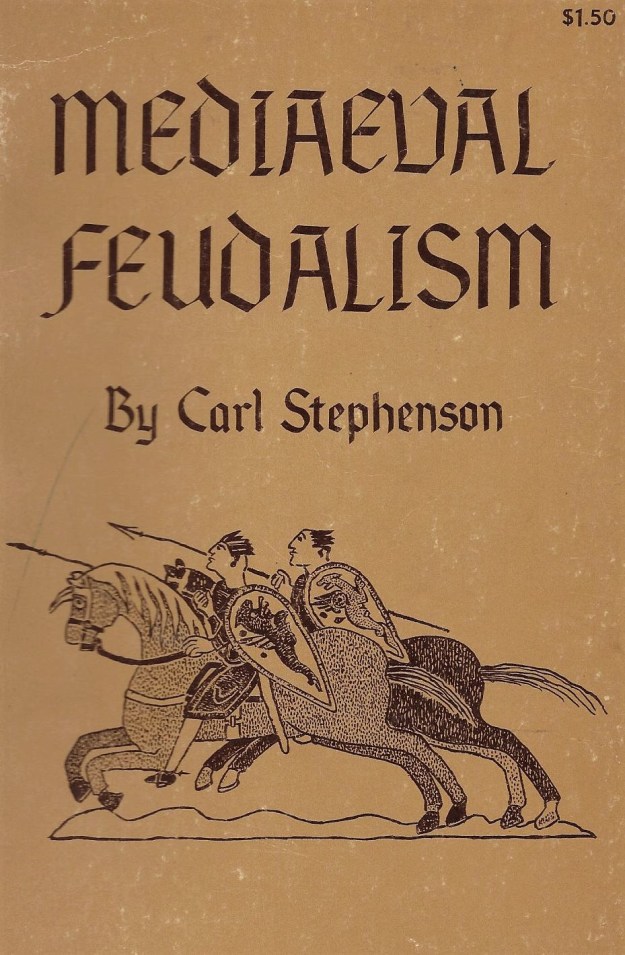
I have kept and treasure the books from my medieval history courses.

Stephenson

“Wish We Had Satchel Paige to Pitch”


Satchel Paige – Daily Worker 10-8-1940 pg 8


“ ‘Wish We Had Satchel Paige to Pitch Pay-Off Game for Us,’ Tiger Players Say”

Daily Worker

October 8, 1940

pg. 8

Cincinnati, Ohio, Oct. 7–With their star pitchers, Newsom, Bridges and Rowe, insufficiently rested for the seventh and critical game of the world series, the cry “Satchel Paige could win for us” rose in the Tiger dressing room this afternoon after the Detroit team lost, 4 to 0, to the Cincinnati Reds. Schoolboy Rowe started it when he called “it looks as if Satchel Paige will pitch for us at 1:30 tomorrow.” Buck Newsom, Tigers’ pitching hero who hails from South Carolina, took it up, saying, “I wouldn’t mind seeing him pitch. He’s one of the greatest in the country. I pitched against him many times out on the coast and only beat him once and then when he had only one day’s rest.”

Rowe chimed in with the remark that McMullen, a catcher, then playing in California, never hit a foul of Paige in half a dozen games. Newsom added: “Charlie Gehringer was the only one who could hit him. He’s got great stuff and we could use him right now. [Tigers catcher] Birdie Tebbetts joined in the praise for Paige saying that he remembered the screen test baseball handicap in 1933 and also in again 1934 when Paige was the outstanding star.

This call for the great Negro pitcher who Buck Newsom called the Negro Rube Waddell came as Del Baker, manager of the Tigers frankly admitted that the Detroit pitching situation was desperate and that he could only pick a pitcher out of his hat.

The next day, October 9, the Tigers lost the seventh game and the Series to the Reds by a score of 2 to 1.


*****************************************************

I came across this news story while doing research (unrelated to sports or baseball) in the Daily Worker in the New York Public Library.

I was surprised to find that the paper, which was priced at five cents and was eight pages long during the 1940s (it was published from 1924 to 1958), was, it seems, an excellent, well written paper, despite its dogmatism and rigid adherence to the Stalinist party line (it was published by the Communist Party USA). It was, besides being totally pro-USSR, very much the champion of workers and unions; and it was against arbitrary exercises of government power as a means of suppression, including abuses by the police. The Daily Worker back then was ahead of its time in that it was very much pro-civil rights — something which can be clearly seen in articles about abuses such as lynchings, targeting of blacks by the police and legal system, and many other examples of discrimination. The paper advocated the desegregation of professional sports.

I recall, I am certain, seeing Satchel Paige pitch once in a televised game. He pitched in the 1953 All Star Game — I was too young then to have watched the game. What I must certainly be remembering is the following game, about which I do not recall any details:

In 1965, Kansas City Athletics owner Charles O. Finley signed Paige, 59 at the time, for one game. On September 25, against the Boston Red Sox, Finley invited several Negro league veterans including Cool Papa Bell to be introduced before the game. Paige was in the bullpen, sitting on a rocking chair, being served coffee by a “nurse” between innings. He started the game by getting Jim Gosger out on a pop foul. The next man, Dalton Jones, reached first and went to second on an infield error, but was thrown out trying to reach third on a pitch in the dirt. Carl Yastrzemski doubled and Tony Conigliaro hit a fly ball to end the inning. The next six batters went down in order, including a strikeout of [Red Sox pitcher] Bill Monbouquette. In the fourth inning, Paige took the mound, to be removed according to plan by [Athletics manager] Haywood Sullivan. He walked off to a standing ovation from the small crowd of 9,289. The lights dimmed and, led by the PA announcer, the fans lit matches and cigarette lighters while singing “The Old Gray Mare.” — Wikipedia

I remember every one of the Red Sox players.

— Roger W. Smith

   December 2019

traveling from Boston to New York in 1842; a Charles Dickens letter


In the 1970’s, when I was living in New York City, I frequently took the train from New York to Boston to visit my family in Massachusetts.

Around 1972, a one way ticket cost $12.00. The price was lowered to $9.90 to encourage more travel. Trains were not in fashion then.

The train meandered slowly, passing through some parts of Connecticut with beautiful coastal scenery. The trip took five hours.

Compare (below) the same trip (in reverse) which Charles Dickens took in 1842, except that, besides train travel between cities (there were trains even back then), there were steamboats and detours.

Dickens left Boston on February 5, 1842, and arrived in New York City on February 12, a trip of seven days. He was traveling with his wife, Catherine Thomson (Hogarth) Dickens.


*****************************************************

We left Boston on the fifth, and went away with the governor of the city to stay till Monday [February 7] at his house at Worcester [Massachusetts]. … The village of Worcester is one of the prettiest in New England. …. On Monday morning at nine o’clock we started again by railroad and went on to Springfield [Massachusetts], where a deputation of two were waiting, and everything was in readiness that the utmost attention could suggest. Owing to the mildness of the weather, the Connecticut river was “open,” videlicet not frozen, and they had a steamboat ready to carry us on to Hartford [Connecticut]; thus saving a land-journey of only twenty-five miles, but on such roads at this time of year that it takes nearly twelve hours to accomplish! The boat was very small, the river full of floating blocks of ice, and the depth where we went (to avoid the ice and the current) not more than a few inches. After two hours and a half of this queer travelling we got to Hartford. There, there was quite an English inn [The City Hotel in Hartford]; except in respect of the bed-rooms, which are always uncomfortable … We remained in this town until the eleventh [Friday, February 11]: holding a formal levee every day for two hours, and receiving on each from two hundred to three hundred people. At five o’clock on the afternoon of the eleventh, we set off (still by railroad) for Newhaven [i.e., New Haven, Connecticut]. which we reached about eight o’clock. The moment we had had tea, we were forced to open another levee for the students and professors of the college [Yale] (the largest in the States), and the townspeople. I suppose we shook hands, before going to bed, with considerably more than five hundred people; and I stood, as a matter of course, the whole time. …

Now, the deputation of two had come on with us from Hartford; and at New­haven there was another committee; and the immense fatigue and worry of all this, no words can exaggerate. We had been in the morning over jails and deaf and dumb asylums; had stopped on the journey at a place called Wallingford [Connecticut], where a whole town had turned out to see me, and to gratify whose curiosity the train stopped expressly; had had a day of great excitement and exertion on the Thursday (this being Friday); and were inexpressibly worn out. And when at last we got to bed and were “going” to fall asleep, the choristers of the college turned out in a body, under the window, and serenaded us! We had had, by the bye, another serenade at Hartford, from a Mr. [Isaac Hull] Adams (a nephew of John Quincey Adams) and a German friend. They were most beautiful singers: and when they began, in the dead of the night, in a long, musical, echoing passage outside our chamber door; singing, in low voices to guitars, about home and absent friends and other topics that they knew would interest us; we were more moved than I can tell you. …

The Newhaven serenade was not so good; though there were a great many voices, and a “reg’lar” band. It hadn’t the heart of the other. Before it was six hours old, we were dressing with might and main, and making ready for our departure: it being a drive of twenty minutes to the steamboat, and the hour of sailing nine o’clock. After a hasty breakfast we started off; and after another levee on the deck (actually on the deck), and “three times three for Dickens,” moved towards New York.

I was delighted to find on board a Mr. [Cornelius Conway] Felton whom I had known at Boston. He is the Greek professor at Cambridge, and was going on to the ball* and dinner. … We drank all the porter on board, ate all the cold pork and cheese, and were very merry indeed. …

About half past 2 [on February 12], we arrived here [New York].** In half an hour more, we reached this hotel [the Carlton Hotel on Broadway], where a very splendid suite of rooms was prepared for us; and where everything is very comfortable, and no doubt (as at Boston) enormously dear.

— Charles Dickens, letter to John Foster, February 17, 1842, IN The Letters of Charles Dickens, The Pilgrim Edition, Volume Three: 1842-1843, edited by Madeline House, Graham Storey, and Kathleen Tillotson; associate editor, Noel C. Peryton (Oxford: Clarendon Press, 1974), pp. 67-70

*The Boz Ball, held on February 14, 1842, in Dickens’s honor, at the Park Theatre in New York City. Boz was a nickname Dickens had become known by — he employed it as a pseudonym in his early years as a writer.

**The final leg of Dickens’s journey was on the packet New York from New Haven, which docked at South Street in lower Manhattan. Dickens would have then traveled uptown to his hotel by stagecoach. The hotel charge was two dollars a night.


— posted by Roger W. Smith

   December 2019