Tag Archives: Roger Smith

a contest of equals?


I heard an incisive comment by a commentator on one of the cable news stations the other day.

Perhaps Kellyanne Conway should be credited for what the commentator observed.

He noted that there is a new standard for political disputes. Facts and falsehoods are on equal footing if enough people believe in the latter.

Fact: Biden won the 2020 election.

Falsehood: The election was fraudulent. Trump was the real winner.

Under the new “rules,” both are granted equal validity as arguing points. A majority of people — it is probably accurate to say — accept as fact that Biden won. But a substantial number believe that Trump won. Therefore, both positions are valid; and have equal status as talking or debating points, and as political and campaign issues.

It as if  two teams were to engage in a debate. The propositions:  Donald Trump lost the 2020 election  … Trump won the election.  The debating positions of each team are considered equally valid.

So it goes, by some de facto consensus, not according to time honored rules of public discourse.

My team, the Boston Red Sox, were the real winners of the 1977 American League pennant. They deserved to win.


*****************************************************

So, to revert to what the commentator was referring to, and to try to make it as clear as possible the absurdity: In politics a situation has now occurred where both sides over issues such as the 2020 presidential election, whether Covid vaccines are safe, etc., believe they have an equal claim to being right, that their views are on an equal footing. Biden won? Trump won? Both are valid positions to hold. Both sides should be given a hearing and taken seriously, because all that matters is that both positions have a substantial number of supporters.

What has become of the clearheaded logic we were taught in school? My grandfather used to say: Never argue about a fact.

You say the president immediately preceding Abraham Lincoln was James Buchanan. No, I say adamantly, you’re wrong. It was Franklin Pierce, and an argument ensues.

A totally pointless argument, as stupid as it would be to argue over who pitched the first perfect game ever.

Just as absurd as arguing over who won the 2020 election. But the Trumpers are not going to give up the argument.

This is a pernicious threat to public (political) discourse and to democracy.


— Roger W. Smith

   January 2020

the Great American Novel II


As an addendum to my post

the Great American Novel

the Great American Novel

I got to thinking today about what I wrote there.

As my friend Charles Pierre told me one evening when we both working the night shift in a Boston warehouse and he was reading Moby-Dick (at around the time when I myself read the novel), it is such an American book — could have only been written here. The famous first line, “Call me Ishmael,” is so American, informal. It greets the reader (and sets the tone of the book) in a way that we and only we address and relate to one another — did in those days.

And the subject matter — whaling and everything else — the characters, the dialogue the political undertones with a war between the states a threat and possibility — Moby-Dick is immediately identifiable as an American book in the way that War and Peace could only be Russian.


*****************************************************

Entering that gable-ended Spouter-Inn, you found yourself in a wide, low, straggling entry with old-fashioned wainscots, reminding one of the bulwarks of some condemned old craft. …

Upon entering the place I found a number of young seamen gathered about a table, examining by a dim light divers specimens of skrimshander. I sought the landlord, and telling him I desired to be accommodated with a room, received for answer that his house was full—not a bed unoccupied. “But avast,” he added, tapping his forehead, “you haint no objections to sharing a harpooneer’s blanket, have ye? I s’pose you are goin’ a-whalin’, so you’d better get used to that sort of thing.”

I told him that I never liked to sleep two in a bed; that if I should ever do so, it would depend upon who the harpooneer might be, and that if he (the landlord) really had no other place for me, and the harpooneer was not decidedly objectionable, why rather than wander further about a strange town on so bitter a night, I would put up with the half of any decent man’s blanket.

“I thought so. All right; take a seat. Supper?—you want supper? Supper’ll be ready directly.” …

Supper over, the company went back to the bar-room, when, knowing not what else to do with myself, I resolved to spend the rest of the evening as a looker on.

Presently a rioting noise was heard without. Starting up, the landlord cried, “That’s the Grampus’s crew. I seed her reported in the offing this morning; a three years’ voyage, and a full ship. Hurrah, boys; now we’ll have the latest news from the Feegees.”

A tramping of sea boots was heard in the entry; the door was flung open, and in rolled a wild set of mariners enough. …

No man prefers to sleep two in a bed. In fact, you would a good deal rather not sleep with your own brother. …

“Landlord! I’ve changed my mind about that harpooneer.—I shan’t sleep with him. I’ll try the bench here.”

“Just as you please; I’m sorry I can’t spare ye a tablecloth for a mattress, and it’s a plaguy rough board here”—feeling of the knots and notches. “But wait a bit, Skrimshander; I’ve got a carpenter’s plane there in the bar—wait, I say, and I’ll make ye snug enough.” So saying he procured the plane; and with his old silk handkerchief first dusting the bench, vigorously set to planing away at my bed, the while grinning like an ape. The shavings flew right and left; till at last the plane-iron came bump against an indestructible knot. The landlord was near spraining his wrist, and I told him for heaven’s sake to quit—the bed was soft enough to suit me, and I did not know how all the planing in the world could make eider down of a pine plank. So gathering up the shavings with another grin, and throwing them into the great stove in the middle of the room, he went about his business, and left me in a brown study.

I now took the measure of the bench, and found that it was a foot too short; but that could be mended with a chair. But it was a foot too narrow, and the other bench in the room was about four inches higher than the planed one—so there was no yoking them. I then placed the first bench lengthwise along the only clear space against the wall, leaving a little interval between, for my back to settle down in. But I soon found that there came such a draught of cold air over me from under the sill of the window, that this plan would never do at all, especially as another current from the rickety door met the one from the window, and both together formed a series of small whirlwinds in the immediate vicinity of the spot where I had thought to spend the night.

The devil fetch that harpooneer, thought I, but stop, couldn’t I steal a march on him—bolt his door inside, and jump into his bed, not to be wakened by the most violent knockings? It seemed no bad idea; but upon second thoughts I dismissed it. For who could tell but what the next morning, so soon as I popped out of the room, the harpooneer might be standing in the entry, all ready to knock me down!

Still, looking round me again, and seeing no possible chance of spending a sufferable night unless in some other person’s bed, I began to think that after all I might be cherishing unwarrantable prejudices against this unknown harpooneer. … But though the other boarders kept coming in by ones, twos, and threes, and going to bed, yet no sign of my harpooneer.

“Landlord!” said I, “what sort of a chap is he—does he always keep such late hours?” It was now hard upon twelve o’clock.

The landlord chuckled again with his lean chuckle, and seemed to be mightily tickled at something beyond my comprehension. “No,” he answered, “generally he’s an early bird—airley to bed and airley to rise—yes, he’s the bird what catches the worm. But to-night he went out a peddling, you see, and I don’t see what on airth keeps him so late, unless, may be, he can’t sell his head.”

“Can’t sell his head?—What sort of a bamboozingly story is this you are telling me?” getting into a towering rage. “Do you pretend to say, landlord, that this harpooneer is actually engaged this blessed Saturday night, or rather Sunday morning, in peddling his head around this town?” …

This account cleared up the otherwise unaccountable mystery, and showed that the landlord, after all, had had no idea of fooling me—but at the same time what could I think of a harpooneer who stayed out of a Saturday night clean into the holy Sabbath, engaged in such a cannibal business as selling the heads of dead idolators?

“Depend upon it, landlord, that harpooneer is a dangerous man.”

“He pays reg’lar,” was the rejoinder.

— CHAPTER 3, “The Spouter-Inn”


It was quite late in the evening when the little Moss came snugly to anchor, and Queequeg and I went ashore; so we could attend to no business that day, at least none but a supper and a bed. The landlord of the Spouter-Inn had recommended us to his cousin Hosea Hussey of the Try Pots, whom he asserted to be the proprietor of one of the best kept hotels in all Nantucket, and moreover he had assured us that Cousin Hosea, as he called him, was famous for his chowders. …

Two enormous wooden pots painted black, and suspended by asses’ ears, swung from the cross-trees of an old top-mast, planted in front of an old doorway. The horns of the cross-trees were sawed off on the other side, so that this old top-mast looked not a little like a gallows. Perhaps I was over sensitive to such impressions at the time, but I could not help staring at this gallows with a vague misgiving. A sort of crick was in my neck as I gazed up to the two remaining horns; yes, two of them, one for Queequeg, and one for me. It’s ominous, thinks I. A Coffin my Innkeeper upon landing in my first whaling port; tombstones staring at me in the whalemen’s chapel; and here a gallows! and a pair of prodigious black pots too! Are these last throwing out oblique hints touching Tophet?

I was called from these reflections by the sight of a freckled woman with yellow hair and a yellow gown, standing in the porch of the inn, under a dull red lamp swinging there, that looked much like an injured eye, and carrying on a brisk scolding with a man in a purple woollen shirt.

“Get along with ye,” said she to the man, “or I’ll be combing ye!”

“Come on, Queequeg,” said I, “all right. There’s Mrs. Hussey.”

And so it turned out; Mr. Hosea Hussey being from home, but leaving Mrs. Hussey entirely competent to attend to all his affairs. Upon making known our desires for a supper and a bed, Mrs. Hussey, postponing further scolding for the present, ushered us into a little room, and seating us at a table spread with the relics of a recently concluded repast, turned round to us and said—“Clam or Cod?”

“What’s that about Cods, ma’am?” said I, with much politeness.

“Clam or Cod?” she repeated.

“A clam for supper? a cold clam; is that what you mean, Mrs. Hussey?” says I, “but that’s a rather cold and clammy reception in the winter time, ain’t it, Mrs. Hussey?”

But being in a great hurry to resume scolding the man in the purple Shirt, who was waiting for it in the entry, and seeming to hear nothing but the word “clam,” Mrs. Hussey hurried towards an open door leading to the kitchen, and bawling out “clam for two,” disappeared.

“Queequeg,” said I, “do you think that we can make out a supper for us both on one clam?”

However, a warm savory steam from the kitchen served to belie the apparently cheerless prospect before us. But when that smoking chowder came in, the mystery was delightfully explained.

— CHAPTER 15, “Chowder”


– posted by Roger W. Smith

   January 2022

jealousy


If I may engage in a bit of psychologizing — ruminating upon personal experience — recent experience got me engaging in reflections as follows. Actually, the events — or my reflections — involved to a great extent past experiences.

A friend abruptly and bitterly broke off relations with me years ago, terminated our friendship. It happened around the time of my marriage. My friend was a bachelor. It is not worth going into the details, but he was a very close friend and it was painful.

My therapist at the time (paraphrasing closely my therapist’s words) told me: Jealousy is the hardest of human emotions to overcome.


*****************************************************

In my usual fashion, I have, with respect to recent unpleasant experiences, been ruminating on this and trying to analyze and thrash it out in my mind, and in conversations with my wife.

When engaged in such thinking, I often think “anecdotally,” try to recall and analyze events from my past that seem pertinent. Examples ranging from major to seemingly trivial ones come to mind.

To give one example: An in-law of mine was inclined to be a social climber. Once, a long time ago, when I was into genealogy, I took a trip to Boston to do genealogical research. When I got back home, this relation (the in-law) was visiting us. She asked me how was your trip to Boston? She knew nothing about my interest in genealogy, but she herself had done some genealogical research, brief enquiries, and had written a brief, half-baked genealogy of her own family.

She asked how was your trip? I had just returned home. This was pre-internet days. All research was done on site in libraries and involved making photocopies of documents. I had them in hand. I answered innocently, telling her that (now that she had asked) it was a very successful trip. How in a genealogical journal I had found a long article by two leading genealogists about my mother’s family, tracing her ancestry from English settlers on Cape Cod in the early 1600s right down to her grandfather, who was named in the article, proving that this was indeed my mother’s family.

My in-law was angry. She said something to the effect of: That’s not your family. She was sure I had made something up.

I replied that this really was my mother’s family, but she wasn’t listening.

What she thought or whether she believed me did not matter to me. I merely note her reaction. She was visibly angry. The question arises: about what?

The way I perceive this is as follows. My in-law was angry to think that I might be putting on airs or whatever, but we were not close and she knew nothing about my family or ancestry. She was angry because my claims to be descended from original Yankee settlers might confer distinction on me somehow, and she lacked such “credentials.” But I had done nothing to offend her. I had merely answered her question about my research trip.

She took my research — which would not a priori have been of any interest to her, and which had nothing to do with her ancestry — personally.

So here’s what I have concluded (in retrospect). Jealousy involves a situation in which the jealous person is resentful about something that the other person can claim, has done, etc. You get married, discover something impressive about your ancestors, achieve something . This activity, these accomplishments, of yours have nothing to do with the other person — were not directed at him or her.

I got married. My friend was single. Was I thinking about him when my wife and I decided to get married? Did I somehow want to distinguish myself from or “get ahead” of him? Of course not. But he took it personally.

It is true that by getting married I was achieving a status or position in society that my unmarried friend had not obtained; and marriage confers a measure of distinction and respect in the eyes of society. But at any given time in different age groups there are unmarried as well as married people. My wife and I had many friends who were unmarried. My getting married did not anything to do with any of my friends or this one in particular, as I have already said.

My wife had a situation where a close friend from her childhood and youth became surly and ceased communications at a point later in their lives, inexplicably. It happened around the time my wife and I were married. My wife at some point mentioned to her friend, who had relocated to a different part of the country, in passing (she is not the sort of person to ever boast or brag) that I was doing freelance writing. Suddenly her friend was talking about her husband’s accomplishments in business and how he had written a training manual for the firm; she said he had published a book.

My wife and I had two sons. Perhaps this made my wife’s friend jealous. She had one son. I don’t know, but she was regaling my wife all the time with stories about her son’s success in sports and so forth. And then she ceased communicating.

My wife is the last person to ever try or want to outdo someone when it comes to bragging rights. She is not competitive in that sense. But just telling her friend some things that she was happy about and proud of was enough to make her friend jealous.


*****************************************************

You publish your first book. You tell a friend the good news: My book has been accepted for publication. Your friend is interested in writing and has thought or fantasized about being or becoming a writer themselves. Your good news makes them angry or resentful, something you did not foresee.

Besides being liked and loved, everyone wants to be admired and praised. Or, to put it another way, nobody doesn’t welcome this. This is not, in and of itself, indicative of self-centeredness or narcissism.


*****************************************************

To try to get my point across succinctly. The above examples may not be that instructive or enlightening, but I think what occurs in such situations — with jealousy — is that the jealous person somehow takes your success — whatever it is that makes them jealous — PERSONALLY. When, in fact, it has nothing to do with them.

Your success or happiness somehow – for no apparent reason, with no obvious cause –- angers them.

I think of all the things true of people I know or have known: riches, titles, entitlements or opportunities that they have and I lack. Or that they did — that was the case — at some former point in my life when I might have desired such things. And friends or acquaintances of mine in the distant past who seemed to be more successful professionally and/or socially than I was. I may have felt something like envy, wished I had such a job title or a girlfriend. But that’s as far as it went.

As is true in the case of most people, I may and would — or probably do — consider these things nice to have, if I did have them myself. But I don’t give them another thought, and I am not consumed with anger or jealousy over what I do not have or have not achieved.


posted by Roger W. Smith

    January 2022

Barbara Grizzutti Harrison, “Joan Didion: Only Disconnect”


Barbara Grizzutti Harrison’s Essay “Joan Didion: Only Disconnect” is online at

https://www.writing.upenn.edu/~afilreis/103/didion-per-harrison.html

It complements my post

Joan Didion and NYC

Joan Didion and NYC


— Roger W. Smith

  December 2021

Joan Didion and NYC


Joan Didion – Saturday Evening Post 1-4-1967


Reading Joan Didion’s obituaries this week, I was reminded in particular of an essay of hers I had heard about. I don’t think I have read it before. (It is posted here, above.)

Joan Didion

“Farwell to the Enchanted City” (subsequently republished as “Goodbye to All That”)

Saturday Evening Post

January 4, 1967

I desired to read it. I wanted to see what she thought about New Yok City when she first moved there from California, in the late 1950s. About ten years later, I myself first relocated to New York and settled there.

What things about the City attracted and delighted her? Repelled her?


*****************************************************

When I moved to New York, it both fascinated (I found it intoxicating) and overwhelmed me with a sort of fear or numbness (emotional deadness). Meaning that it was so impersonal; the buildings were so tall, dominating the streetscapes; there was no nature; the people were all in a hurry and seemingly cold and impersonal, too busy and goal oriented to talk to you.

Everything depended on having money, of which I had very little.

I had been to New York a very few times before. The first time was in 1954, when my parents took me to visit the City for a few days. We stayed in the Edison Hotel in Times Square. (Rooms were four dollars a day. We must have been able to park our car.) I could not get over the experience of the Empire State Building. Being on the observation deck on the top and looking down at the cars on Fifth Avenue, which seemed like toy cars. The Automat. The little windows where you would put a dime or nickel in a slot and get a piece of pie. My mother wanted to see Greenwich Village. We drove around the crooked streets. I don’t think we ever got out of the car. I recall the cobblestones and that the car was jolting.

We took the Staten Island Ferry to cool off. It was July or August and one of those sweltering NYC hot spells.


*****************************************************

As a young man and adult, I grew to love and appreciate — so much — New York. See my post

“I went to the school of New York.”

“I went to the school of New York.”

for one way in which this was true.

The art movie theaters. The bookstores. Libraries. Most of all, the intellectual energy and appetites of the people I got to know.

In Massachusetts, as a young man, I would have been embarrassed to go to a movie by myself. In Connecticut, where I worked briefly, I was once asked to leave a folk music coffee house because I was sitting at table by myself. In NYC, no problem. I went to movies almost always by myself. Good way to spend an evening or a Sunday afternoon if you felt lonely.

Sit at a restaurant table by oneself? No problem. It was the same with half the other customers.

I would go to Central Park on Sunday afternoons and sit on a park bench feeling a bit lonely but like I was an amorphous participant in something. The bars were an oasis. A glass of beer twenty cents. Every third one free. The bartender was your and everyone’s friend.

One day in a subway station, I asked some people a question of some sort (maybe directions). They answered politely and helpfully. I told a friend of mine from college who lived in Flushing, Queens about this.

“Someone was actually nice to me in the subway,” I said.

“New Yorkers are people, too,” he replied.

Indeed.

Wonderful people. So full of energy. So interesting. Except when I first came the people on the subway all seemed so pale and sickly to me.

So what was Joan Didion’s experience?

Read her famous essay (attached).

It’s really about her — instead of, at bottom, the City. It is very self-centered. It is surprising how much it seems to be built upon – – to be a tissue of — generalities. Of musings, inner thoughts. It does not convey much INFORMATION, substance.

You learn hardly anything about what New York was like when she was there.


*****************************************************

“Joan Didion: Only Disconnect”

From Off Center: Essays by Barbara Grizzutti Harrison

I do not find Joan Didion appealing. … I am disinclined to find endearing a chronicler of the 1960s who is beset by migraines that can be triggered by her decorator’s having pleated instead of gathered her new diningroom curtains. … more …. of a neurasthenic Cher than of a writer who has been called America’s finest woman prose stylist. … her subject is always herself. …

Didion uses style as argument. … for Didion, only surfaces matter. … Didion tells us, many times, and in many ways, that her mind “veers inflexibly toward the particular.”

To what in particular?


*****************************************************

Enough said. Read Joan Didion’s essay if you feel like it.


— posted by Roger W. Smith

   December 25, 2021


*****************************************************

Facebook comments

December 25, 2021


Pete Smith

Interesting thoughts. But don’t most writer’s thoughts relate largely to themselves? Think of Truman Capote’s short stories, like Dazzle. Or Melville, talking as himself (Ishmael) throughout Moby-Dick. I don’t object to your objecting to Didion but were she still alive she might have the same complaints about those of your posts, including this one, that borrow heavily on your own experience. I think this is what makes your posts interesting, and don’t see why it wouldn’t also apply to Didion’s writing.


Roger W. Smith

Barbara Grizzutti Harrison’s essay is dead on. You should read it. You are wrong about my writing. Of course everyone writes about and from the perspective of themselves and their own experience. This post insofar as it relates to me is built on experiences I had that readers can relate to.


Pete Smith

Roger, I think your reply was hidden for some reason but you missed my point. I was not criticizing you for writing about your own history or own perspective; I was basically saying that that is what everyone usually does and that I found it odd that you were criticizing Joan Didion for doing so — and I was acknowledging that this did not mean you had to like her writing. . . .


Roger W. Smith

I was criticizing her writing — from a certain point of view (view of her writing); which of course does not mean that writers should not write about themselves. Harrison’s essay articulates what I was trying to say; I had not read it before. By the way, Melville created a character, Ishmael, that was sort of his alter ego, but to say that amounts to writing about oneself is not correct. I guess the best way to put it is that Didion’s writing seems overly self-absorbed and there is something missing content- or sustenance-wise that a reader wants to be able to take away. I read some Didion before, including one of her novels. I was sort of impressed then, but now have come to the opinions of my post.


Pete Smith

All I meant was that Melville’s writing, like Truman Capote’s and like much of yours, was based on his own personal experience — in his case, whaling. I can understand your comment about Didion’s self absorption but when she’s writing a book all about the tragic and terrible year of her husband’s death, I would guess it would be difficult for any passionate observer to accuse her of self-absorption.


Roger W. Smith

I have not read [Joan Didion’s] The Year of Magical Thinking. I began this post with one essay of Didion’s which disappointed me and, based upon which, I drew inferences about her writing which seem valid. She always wrote about herself in a way that Melville didn’t.


Pete Smith

Got it, but of course you understand that I wasn’t suggesting in any way that Melville and Didion wrote about themselves in the same way.


Roger W. Smith

No, I don’t think that (your first sentence).


Ella Rutledge

I’m no fan of Didion’s either. The only thing of hers I have read is The Year of Magical Thinking. (I think a negative review at amazon.com called it “A Lifetime of Magical Thinking.”) She is a member of the NY literati and so they all praise her writing because she writes from their point of view. You, Roger, on the other hand, document and record NYC life from an “everyman” perspective. I hated that book. So shallow, so limited, in its view of grief, grieving, loss, death, faith, belief in anything other than the material world, of which she constantly reminded us with references to the best hospitals (reached by helicopter), the best doctors, Brooks Brothers suits, Hollywood and the Beverly Hills Hotel. Death is final and any tendency to hope for anything beyond is “magical” (or in her view deluded) thinking.


Roger W. Smith

Thanks very much for the incisive comments, Ella, What you say about The Year of Magical Thinking confirms what I have said. I based my comments (mainly) on the essay I read this morning and on Harrison’s devastating article about Didion. And, yes, I did see what I felt was a distinction between my own writing and hers — or do now — it wasn’t my main point, and I was thinking about her writing, not mine, but when I read her essay about leaving New York, I felt empty; and I realize now, in retrospect, that that is more or less how I felt years ago when I read “Play It As It Lays.”

Vivaldi was a violinist.


Antonio Vivaldi’s father, Giovanni Battista Vivaldi, … was a barber before becoming a professional violinist, and was one of the founders of the Sovvegno dei musicisti di Santa Cecilia, an association of musicians. He taught Vivaldi to play the violin and then toured Venice playing the violin with his young son.

In September 1703, Antonio Vivaldi became maestro di violino (master of violin) at an orphanage called the Pio Ospedale della Pietà (Devout Hospital of Mercy) in Venice. While Vivaldi is most famous as a composer, he was regarded as an exceptional technical violinist as well. The German architect Johann Friedrich Armand von Uffenbach referred to Vivaldi as “the famous composer and violinist” and said that “Vivaldi played a solo accompaniment excellently, and at the conclusion he added a free fantasy [an improvised cadenza] which absolutely astounded me, for it is hardly possible that anyone has ever played, or ever will play, in such a fashion.” — “Antonio Vivaldi,” Wikipedia


— posted by Roger W. Smith

  December 2021

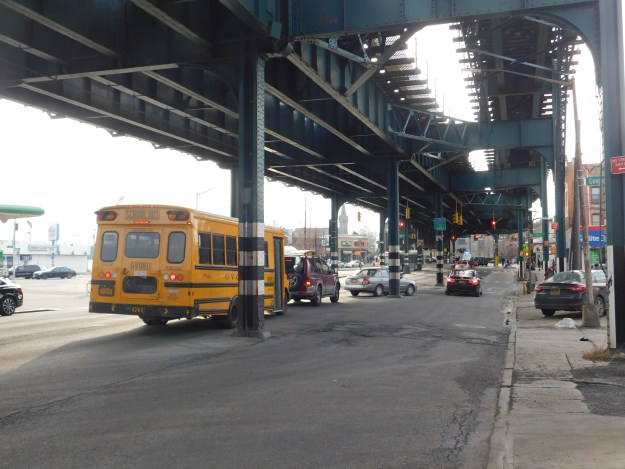
This is what Robert Moses did to the Bronx.


photos by Roger W. Smith


These photos of mine illustrate that the affected areas of the Bronx are not “walkable.”  As I experienced in a walk from Pelham Bay Park in the Bronx all the way back to Manhattan’s East Side.

Imagine if Moses had managed to do the same thing (he came very close to succeeding) to the Village and Soho, ruining much of Lower Manhattan. I shudder to think of it when I contemplate how much I enjoy walking from the Battery uptown, or walking downtown along Broadway.


*****************************************************

The Cross Bronx Expressway was the brainchild of Robert Moses. But historically it has been blamed for bisecting the Bronx roughly in half causing a migration of middle and upper class residents to the north and leaving the south portion to become an underserved slum of low-income residents. It displaced as many as 5,000 families when an alternate proposed route along Crotona Park would have only affected 1-2% of that amount. Robert Moses is accused of favoring “car culture” placing an importance on building highways instead of subways in order to grow the city. The construction of large highways like the CBE shelved greater NYC Transit projects including the Second Avenue Subway. Not only did it have these ill effects, but to this day the expressway remains a headache for commuters with stacked and entangled roadways such as the Highbridge and Bruckner Interchanges.

The Sheridan Expressway [in the Bronx] is the work of Robert Moses as well and to this day remains unchanged from its original construction. Not only has it become an eyesore for the Hunts Point community which falls directly under several lanes of highway overpass, but according to a recent NYC Department of City Planning report, its surrounding areas are “congested, confusing, and unwelcoming.”

https://untappedcities.com/2013/12/18/5-things-in-nyc-we-can-blame-on-robert-moses/


*****************************************************

Jane Jacobs was the key figure in organizing opposition to and defeating Robert Moses’s plans to extend Fifth Avenue through Washington Square Park in Manhattan; to designate the West Village as a “slum,” which would have meant essentially razing the neighborhood; and, most importantly (and most frightening), to build a Mid-Manhattan Expressway that would have destroyed the character of much of Lower Manhattan and, in the final analysis, of Manhattan itself. It was the beginning and then the apotheosis of Moses’s downfall.

As one film critic has observed, “Jane Jacobs was the David to Robert Moses’s Goliath.” She succeeded against what seemed to be impossible odds.

from a previous post of mine

good riddance to urban renewal

good riddance to urban renewal

In my opinion, [Jane Jacobs] is up there with some of the great thinkers and writers who very simply take a fresh look at prevailing opinions and wisdom, go back to square one — or “first principles” — and, in plain language, without overtheorizing — looking with their own eyes — get us to see the world anew. It’s sort of like an Emperor’s New Clothes phenomenon.

How did she manage to defeat Robert Moses? At the outset, I am sure it would have been regarded as quixotic to try. If Moses had rammed an expressway through the Village and Soho, it would have ruined Manhattan — is the word rape too strong?


*****************************************************

Also posted here (Word document below):

“The Dutch Prime Minister Is a Big Fan of Robert Caro,” By John Leland, The New York Times, May 13, 2016

‘The Dutch Prime Minster Is a Big Fan of Robert Caro’ – NY Times 5-13-2016


*****************************************************

See also:

See also:

a significant (glaring) omission

a significant (glaring) omission


— posted by Roger W. Smith

  December 2021; updated March 2024

dealing with a blow (death)


My wife and I just got the totally unexpected news from one of our best, dear friends that his wife died yesterday.

She had been ill for some time. She was immobilized, bedridden, for a good part (if not most) of the time, and needed constant assistance. Our friend, who is retired, had little time to himself. When he wasn’t at home caring for her, he was out doing errands such as shopping for food and taking care that other necessities were met. He never complained. That is not his nature.

Yesterday, our friend’s wife managed to attend Thanksgiving dinner nearby with a son and in-laws, accompanied by her husband. She died suddenly on the way home.


*****************************************************

I couldn’t help thinking of the worst experience, without question, I had of death; and probably the worst experience of my whole life: my mother’s death at a young age from cancer.

It nearly tore our family apart. Not because of any disagreements among us (in the nuclear family), but just because of losing our mother and our father his wife.

Two things that I shared with my wife on hearing the news today of the death of our friend’s wife were as follows.


*****************************************************


When my mother became gravely ill, and treatments appeared not to have been successful, I sank into a state of depression, as did my father and siblings. (Our father’s mental state — depression — seemed the worst.)  Yet, it was sort of “abstract,” in a way, at this point. I couldn’t quite contemplate my mother’s death.

By the time she died, a few months later, I had somehow — partly from talking about my mother’s condition with friends — become more realistic or “objective,” or however one might put it. I was no longer denying that my mother’s illness was terminal.

Yet, when my mother died, inevitably, after a short period during which she was at home briefly and then returned to the hospital, it was a terrible blow. The way I perceived it was: I knew in my rational mind she would not get better and was going to die, but not today.

She died in the spring. I made a visit to my father that summer. He did not talk about my mother, as I recall. He seemed less depressed than he had been a few months before.

I brought this up with my therapist. I said something to him to the effect of, my father looks almost happy. He is active again, enjoying life.

My therapist replied that this was normal: enjoying life. My father, he said, was resuming his life. His zest for it.

Death in such circumstances — unendurable to contemplate, something you are never prepared for — can also be a release and a relief.

Roger W. Smith

   November 26, 2021

my student essay on Tolstoy


Roger’s biographical sketch of Tolstoy

my Tolstoy essay – typed version

my Tolstoy essay – TRANSLATION


I am posting it again.

I am very proud of it. It was written in the 1970s.

I told my therapist, Dr. Colp, that I was taking an advanced Russian evening course at NYU.  l said that based on my previous study, I belonged in the intermediate course, but I wanted to be challenged. Made sense to him.

The paper was based on oral presentation in class. Dr, Colp wasn’t given to fulsome praise. But when I told him I gave a talk in Russian, he was impressed — “in Russian?” he said.

I learned Russian script in the introductory course I took, but I have forgotten it mostly and could not do as I did then: produce a handwritten paper.


— posted by Roger W. Smith

   November 2021

it don’t exactly curve


… toward the end of his life, … [Walt] Whitman saw that baseball was beginning to reflect some unsettling cultural changes. … the game … seemed to be conforming to anti­democratic tendencies in the culture. One particular rule change symptomatic of the overall drift of the sport particularly bothered Whitman. [Horace] Traubel records Whitman’s concern in May 1889; Thomas Harned, a devoted friend, had come to see Walt after attending a baseball game, and Whitman jumped at the chance to talk about the state of the sport:

Tell me, Tom-I want to ask you a question: in base-ball is it the rule that the fellow who pitches the ball aims to pitch it in such a way the batter cannot hit it? Gives it a twist-what not-so it slides off, or won’t be struck fairly?

Harned affirmed that this indeed was the case, and Whitman’s response indicates that he still followed the game even if he was now too debilitated to attend: “Eh? That’s the modern rule then, is it? I thought something of the kind-I read the papers about it-it seemed to indicate that there” [Horace Traubel, With Walt Whitman in Camden, 5:145].

The rule that concerned Whitman has to do with the way the ball could be pitched. The original Knickerbocker rule forbade the throwing of the ball; instead, the ball had to be pitched underhand, smoothly, so that the batter could hit it. This rule had been refined over the years, first requiring that the hand not be raised above the hip, then requiring only that the hand pass below the hip as the ball was pitched, then only below the waist, then the shoulder (allowing for sidearm pitching). Originally, then, the pitcher’s function was simply to put the ball in play by allowing the batter to hit it; one player usually pitched all the games. But as the skills of the players became more refined, the pitcher’s role became more strategic. In 1884 the National League removed all restrictions on a pitcher’s delivery, and by 1887 batters could no longer call for high or low pitches. The curveball, which occasionally had been accomplished underhand-style in the 1870s, now became a requisite skill. Whitman, however, was not impressed with this new skill and saw the rule change as endemic of the deception and lack of openness he saw creeping everywhere into America; we can hear echoes of the anger and despair of Democratic Vistas in his response to Harned, “denounc[ing] the custom roundly,” as Traubel tells us:

The wolf, the snake, the cur, the sneak all seem entered into the mod­ern sportsman-though I ought not to say that, for a snake is a snake because he is born so, and man the snake for other reasons, it may be said.” And again he went over the catalogue-“! should call it everything that is damnable.”

Harned is described as “amused” at Whitman’s response, but Whitman seems in earnest. He has obviously had the matter on his mind for some time and has engaged in some lively debate about it: “I have made it a point to put the same question to several fellows lately. There certainly seems no doubt but that your version is right, for that is the version everyone gives me” (With Walt Whitman in Camden 5:145).

— Ed Folsom, Walt Whitman’s Native Representations (Cambridge University Press, 1994), pp. 46-47


*****************************************************

I was playing sandlot softball and baseball into my mid-50s. My hitting seemed to get better as I got older. I recall one pitcher though, Edward ______ — much younger than me, of course — on a playground in Queens whom I couldn’t hit. A fat pitch would come in slow, looked so tempting, I would swing, and the ball would break DOWN under my bat. Mightily swing and a miss. “I can never seem to hit you,” I said to Edward once. He laughed. “it’s always lights out for you?” he said.


posted by Roger W. Smith

  November 2021