Category Archives: personal reminiscences of Roger W. Smith

a memory


“Well,” his father said, “reckon I’ll hoist me a couple.”

They turned through the swinging doors into a blast of odor and sound. There was no music: only the density of bodies and of the smell of a market bar, of beer, whiskey and country bodies, salt and leather; no clamor, only the thick quietude of crumpled talk. Rufus stood looking at the light on a damp spittoon and he heard his father ask for whiskey, and knew he was looking up and down the bar for men he might know. But they seldom came from so far away as the Powell River Valley; and Rufus soon realized that his father had found, tonight, no one he knew. He looked up his father’s length and watched him bend backwards tossing one off in one jolt in a lordly manner, and a moment later heard him say to the man next him, “That’s my boy”; and felt a warmth of love. Next moment he felt his father’s hands under his armpits, and he was lifted, high, and seated on the bar, looking into a long row of huge bristling and bearded red faces. The eyes of the men nearest him were interested, and kind; some of them smiled; further away, the eyes were impersonal and questioning, but now even some of these began to smile. Somewhat timidly, but feeling assured that his father was proud of him and that he was liked, and liked these men, he smiled back; and suddenly many of the men laughed. He was disconcerted by their laughter and lost his smile a moment; then, realizing it was friendly, smiled again; and again they laughed. His father smiled at him. “That’s my boy,” he said warmly. “Six years old, and he can already read like I couldn’t read when I was twice his age.”

Rufus felt a sudden hollowness in his voice, and all along the bar, and in his own heart. But how does he fight, he thought. You don’t brag about smartness if your son is brave. He felt the anguish of shame, but his father did not seem to notice, except that as suddenly as he had lifted him up to the bar, he gently lifted him down again. “Reckon I’ll have another,” he said, and drank it more slowly; then, with a few good nights, they went out.

— James Agee, A Death in the Family


*****************************************************

I sent the following email to my brothers and my sister this afternoon:

to my siblings

I am in a favorite bar near Carnegie Hall. The waitresses are so nice to me.

A guy just walked in with a little kid under five. They are sitting in a booth right next to me.

It triggered a memory which made me feel very sentimental. I have not thought about it for years.

I wound up at a bar with Dad, probably in Cambridge, when I was around six or seven.

I sat on a barstool. Everyone — the bartender and everyone else — was so nice to me. They treated me like an honored guest.

The bartender gave me a bowl of potato chips …. how I enjoyed them!

I was bathed in warmth and kindness.

miss Dad terribly

ROGER


— posted  by Roger W. Smith

    July 31, 2021


Walden Pond, Concord, Mass., early 50’s. My father, me, and my two brothers. I am the furthest to the left.

a tale of … (which two cities)?


I have been corresponding with a second cousin of mine from my mother’s side of the family. My second cousin lives on the West Coast.

We are catching up on genealogy, mostly. But I have shared a few tidbits (stories). We never met before, although I had some correspondence prior to his passing with my second cousin, Margaret’s, father.


*****************************************************

August 20, 2020

Dear Margaret,


Aunt Etta [my mother’s aunt; my and Margaret’s great-aunt] used to spend Thanksgivings with us. I always looked forward to it. You might enjoy my blog post about Thanksgiving at

Thanksgiving

Near the end of her life, Aunt Etta missed a Thanksgiving. She had moved out of her apartment (I think near Copley Square [in Boston]) to an assisted living place that was very nice. I said to my parents after dinner: I miss Aunt Etta. I am going to visit her. My younger brother went with me. We took the family car. Aunt Etta looked frail but otherwise okay. She was very pleased to see us and appreciated the visit. It was the last time I saw Aunt Etta. [I sensed this, had a premonition.]


*****************************************************

August 21. 2020

Dear Margaret,


A couple of stories about Aunt Etta.

She used to always say “extry” instead of “extra.” I think my mother was her favorite niece or nephew. She liked my mother, and why not? My mother was gracious and just plain nice to everyone. I talked about this aspect of her in one of my blog posts. May I share it with you?

Some people aren’t interested in people.

My mother was annoyed that Aunt Etta belonged to the DAR because of its anti-Black stance. My mother was very pro civil rights. But they did not come to blows over this. Aunt Etta was justifiably proud of her great-grandfather William Handy and had an interest in genealogy and local history. William Handy’s revolutionary war experience is covered in my post at

my Revolutionary War ancestor

In the 1950’s, Aunt Etta — who was always thoughtful and people-oriented, and who seemed to have values much like my grandfather Ralph, her brother (who died when I was an infant) — invited my older brother and me to spend a weekend at her apartment in Boston. She went out of her way to make it an enjoyable visit.

On a Saturday, she took us skating on the Boston Common. My brother was a good skater, I wasn’t. Aunt Etta did not go skating herself. I remember her lacing up our skates in the freezing cold. Her fingers were numb. She was a very un-self-centered person. It did not seem to be a nuisance to her to have to wait for us in the freezing cold.

When we got back to her warm, cozy apartment, we were watching TV or reading magazines and we somehow mentioned Elvis Presley. My brother and I were Elvis fans. Aunt Etta said she didn’t quite know what she thought about him, but, she said, he sure had long “side whiskers” (her word for sideburns). Little things intrigued her.

Aunt Etta brought out a plate of brownies she had baked. They had pecans in them. I meticulously removed all the nuts before eating my brownie. Aunt Etta thought that was so funny. I spent all morning chopping up those nuts, she said. She wasn’t angry, just highly amused.

I believe this was true of my grandfather Ralph, from what I was always told, it was certainly true of my mother; and also of Aunt Etta, whom I knew well, but not intimately — they were all modest and the opposite of pushy, and just plain decent, as well as nice.


*****************************************************

August 27, 2020


Dear Margaret,

A story or two which I just recalled.

The one time I met Uncle Rob [Robert S. Handy, my grandfather’s brother and mother’s uncle; he was a cranberry farmer on Cape Cod], he said one thing to me that I remember distinctly. He told me to buy a house at the first opportunity. He said that that was the best move I could make to ensure financial security.

I was single, probably in my early twenties. I had just graduated from college. The thought of buying a house seemed hard to grasp for me then.

Aunt Etta, as you no doubt know, was frugal and money conscious. She gave me $2,000 on Christmas 1967. It was a bank book with $2,000 in the account. It seemed like a huge gift. She told me — then, or around that time — how she had opened her first bank account when she was young and her father [Henry T. Handy] had advised her to do so and keep her money so it could grow. She wanted to give me helpful advice. I listened but did not pay that much heed then. I was kind of the starving poet type.


*****************************************************

September 14, 2020

Dear Margaret,

I thought you would find this memorial tribute to Jill Jillson [daughter of my mother’s cousin Carol (Handy) Jillson] of interest.

Jill and I were about the same age and we would see her and her siblings on visits, usually to the Cape, with my mother’s cousin Carol (Handy) Jillson and her husband, Jack Jillson.

Somehow it got mentioned to me once that Jack Jillson [Jill Jillson’s father, husband of my mother’s cousin Carol] was a Harvard grad, like my father. I said to my mother, he went to Harvard, really? He was quiet (soft spoken) and self-effacing, and he didn’t seem quite like a “blue blood” (not that my father was) or intellectual.

“He hides his candle under a bushel,” my mother said.

In my freshman year in high school, the Jillsons were visiting us in Canton [Massachusetts]. My father and Jack Jillson were on chaise longues in the back yard. It was a hot day. I was reading Dickens’s A Tale of Two Cities for English class. I mentioned this, and Jack said, what two cities: Baltimore and St. Louis? They both thought this was very funny.


— posted by Roger W. Smith

   September 2020


Etta H. Handy (Aunt Etta)

Robert S. Handy (Uncle Rob)


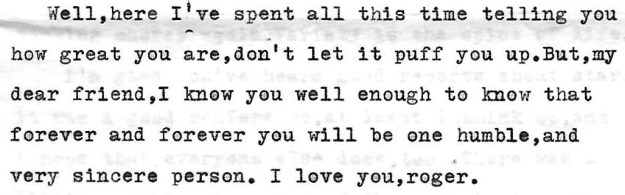
“I … know that …”


Above is an excerpt (the peroration) from a letter I received from a friend, Kathy Phair of Harvard, Massachusetts, in July 1964. At the time of the letter, Kathy was working at a Girl Scout camp in Harvard, and I had a summer job on Cape Cod.

Kathy was, when we first met, the friend of a good friend of mine. We (she and our friend Tom; they were both from Harvard, Massachusetts) used to do things together as a threesome. We had some wonderful times.

We met at meetings and conferences of our church youth group, Liberal Religious Youth.

*****************************************************

Why post this quote? Some will say it is narcissism, egotism, on my part.

Undoubtedly some of my spiteful relatives will.

I am posting it because I know that, for a fact, I haven’t changed, as my wife and some of my close friends realize. The part about being “one humble, and very sincere person” meant and still means a lot to me.

The last time I saw Kathy was in my early twenties. She came to visit me where I was living then, near Boston. We went together to a poetry reading by the poet L. E. Sissman in Kathy’s hometown, Harvard.

Kathy died shortly afterward (at which time she was married) from an illness of long duration which had begun at an early age. She never complained about it.


photo of a wedding ceremony that Kathy and her husband John Waite (both far right) attended in the early 1970s

— Roger W. Smith

   September 2020

Joshua Prawer


English Society in the Early Middle Ages


In the spring 1966 semester, I took the course History 124a, “Feudalism: Medieval Society and Political System,” at Brandeis University.

The course was taught by Professor Joshua Prawer. Prawer, who was a visiting professor on leave for the academic year, was dean of the Faculty of Humanities at Hebrew University in Jerusalem. He was an internationally known medieval historian. Books which he later published include The Latin Kingdom of Jerusalem: European Colonialism in the Middle Ages, The World of the Crusaders, Crusader Institutions, and The History of the Jews in the Latin Kingdom of Jerusalem.

I took great courses and did well in my first two years of college. I had placed out of a few required core courses, which enabled me to take several higher-level elective courses.


*****************************************************

Despite enjoying the courses — greatly — I was a shy, inhibited person in those days, and I was unhappy with the social milieu at Brandeis. I tended to be repressed and taciturn. And diffident among other students and probably in class as well. (I can’t exactly recall.)

I recall that there was no final exam for Professor Prawer’s course, in which I received a final grade of B. There was a required term paper.

My term paper was based on the English historian Doris Mary Stenton’s English Society in the Early Middle Ages (1066–1307), which was published in 1951 as the third volume of the Pelican History of England. She was the wife of the medievalist Sir Frank Stenton, author of Anglo-Saxon England, c550–1087, Volume II in the Oxford History of England.

I recall that I worked fairly hard on the paper and enjoyed Doris Mary Stenton’s book. I was very interested in medieval history and society. I seem to recall that my paper mostly amounted to summarizing the contents and findings of the book and I thought that, on that account, it was probably not a great paper.

To my great surprise (really and truly), I got the paper back with only the following (no other comments or marks): an A+ on the top of the first page and the professor’s comment beneath, “Why didn’t you open up more in the seminar?”

If I may say so without bragging, what this seems to show is that a good writer can write well at any time about almost anything, and under constraints and deadline pressure. It must have been my writing that impressed Professor Prawer. I don’t recall that the paper was otherwise remarkable.


— Roger W. Smith

   January 2020

Sixth Avenue on a rainy afternoon; Herman Melville


Sixth Avenue 4-23 a.m. 11-30-2018

Sixth Avenue, New York City; Friday afternoon, November 30, 2018

I took this photo of Sixth Avenue on my way home on Friday afternoon.

It’s been raining a lot in the City this week.

Rain can be a slight inconvenience, like other weather phenomena, but I never really minded it. It can be “nice.”

When I was very young, my mother took me once to my eye doctor, Dr. Johnson, in Boston on a weekday. We went by subway.

The appointment lasted a long time. Going home in the late afternoon, it was dark and rainy. I didn’t mind. I loved having my mother all to myself. When we got home, she put me to bed. She was so kind. She kept saying that I was cold and wet and that I must be very tired: it had been such a long day and we got home late.

Re this photo of Sixth Avenue, this street scene, it reminds me of Herman Melville’s words (in Moby-Dick): “a damp, drizzly November in my soul.”

Thanks to the Good Lord that it came upon me once when I was first living in NYC to read Moby-Dick, in a library copy. What a book!

THE Great American Novel.

*****************************************************

Whenever I find myself growing grim about the mouth; whenever it is a damp, drizzly November in my soul; whenever I find myself involuntarily pausing before coffin warehouses, and bringing up the rear of every funeral I meet; and especially whenever my hypos get such an upper hand of me, that it requires a strong moral principle to prevent me from deliberately stepping into the street, and methodically knocking people’s hats off—then, I account it high time to get to sea as soon as I can.

— Herman Melville, Moby-Dick; CHAPTER 1. “Loomings.”


— Roger W. Smith

   December 2, 2018

the effervescent (sometimes typographically challenged) pedant


I am blessed to come from a family that is very verbal, that delights in oral and written exchanges and expression and in word play. It seems as if they always put things just right, and often they amuse or provide a pleasant surprise with verbal ingenuity.

When I was in college, my brother and his wife gave me a book as a Christmas gift: Samuel Eliot Morison’s The Oxford History of the American People. On the flyleaf, my brother wrote an inscription: “To the effervescent pedant / With love”

I thought of this because of an email exchange I had with my brother this morning.

In the email to my brother, I quoted from my post

“her” instead of “him”; Ms.; and what else?

“her” instead of “him”; Ms.; and what else?

as follows: “The PC types are all for conversation (of the wilderness and the natural environment). Why do they want to tear asunder our language? Like nature, it should be conserved, which does mean embalmed or ossified.”

and, in the email, said:

See any problem with this?

The PC crowd does tend to be loquacious.


*****************************************************

My brother responded as follows:

Cute typo.

Reminds me when you confused “martial relations” with “marital relations,” an apt malaprop that sent Mom into gales of laughter — loving laughter because in part she was enjoying your early advanced vocabulary.


*****************************************************

I wrote back:

All very true, Pete.

Aptly described.

Your memory is impressive.

I had forgotten how I used to get “martial” and “marital” mixed up.

Sometimes, I would make words up, which amused Mom … I used to say, “It’s just the INTRACITIES of life.”

Once I wrote Mom a letter using several big words I had just learned. I said that if she had no objection, I would DESCANT upon a few things. (To descant means to talk tediously or at length.)

She wrote back a letter beginning with, “So, cant me no descants.” She loved word play.


*****************************************************

This was brilliant usage by my mother. The intransitive verb cant (the meaning of which I did not know) is defined thusly:

1: to talk or beg in a whining or singsong manner

2: to speak in cant or jargon

3: to talk hypocritically

I’m trying to remember in which work of literature I first encountered the word descant.  I usually don’t forget such things.

It will come to me.


— Roger W. Smith

  December 22, 2017


Roger W. Smith, piano lover; Rudolf Serkin; my stereo; the Oak Crest Inn


On November 22, I saw a solo piano concert by Sachiko Furuhata-Kersting at Carnegie Hall. Her program consisted of:

Beethoven’s Piano Sonata No. 14 in C-sharp Minor, Op. 27, No. 2 (“Moonlight”)

Beethoven’s Piano Sonata No. 21 in C Major Op. 53 (“Waldstein”)

Schumann’s Fantasy in C Major, Op. 17

Chopin’s famous Scherzo No. 2 in B Minor, Op. 31

I have a particular fondness for the first two pieces, especially the “Moonlight” sonata (though I love the “Waldstein” sonata too, especially the third movement).


*****************************************************

The “Moonlight” sonata has a unique structure, as is explained in a Wikipedia entry:

Although no direct testimony exists as to the specific reasons why Beethoven decided to title both the Op. 27 works as Sonata quasi una fantasia, it may be significant that the layout of the present work does not follow the traditional movement arrangement in the Classical period of fast–slow–[fast]–fast. Instead, the sonata possesses an end-weighted trajectory, with the rapid music held off until the third movement. In his analysis, German critic Paul Bekker states: “The opening sonata-allegro movement gave the work a definite character from the beginning… which succeeding movements could supplement but not change. Beethoven rebelled against this determinative quality in the first movement. He wanted a prelude, an introduction, not a proposition.”’

https://en.wikipedia.org/wiki/Piano_Sonata_No._14_(Beethoven)#Form


*****************************************************

I thought it was a splendid performance, though it seemed to me that Ms. Furuhata-Kersting could have played the second movement of the “Moonlight” sonata (marked Allegretto) a tad more softly.

I was hoping there might be a review of the performance. I was dazzled by her keyboard technique, but I am no expert when it comes to performance mechanics and performance styles. I only know, insofar as I know anything, what I experience as a listener.

Nevertheless, I was thinking about the piano as an instrument, why I love it, what seems to make it so compelling and powerful as a solo instrument. I was thinking about the following:

— it is played with TWO HANDS, which can play off against one other. This is key. It must be incredibly difficult for a pianist to develop the ability to do this;

— it’s a percussive instrument. The keys make the hammer strike with such force. You get hammering sounds, banging sounds. You also get soft, tinkling sounds. It’s hard to fall asleep!

There is such richness and variety of sound in one instrument, such emotional range. (I am speaking simply as a non-specialist listener.)

To hear such things, you almost have to hear a live performance. I was reminded of this when hearing what was Ms. Furuhata-Kersting’s debut Carnegie Hall performance.


*****************************************************

I couldn’t help but think — as is the case with me and everyone else when it comes to music ranging from classical to pop, it seems — of the circumstances under which I first heard the “Moonlight” sonata. I had just begun to become a full-fledged classical musical lover.

It was the summer of 1964. My parents had bought me a portable stereo as a present upon my high school graduation. It seemed like such wonderful gift. I took the stereo with me to Cape Cod, where I had gotten my first ever paid employment, a summer job as a night watchman and night clerk at the Oak Crest Inn in Falmouth Heights, Massachusetts, a ramshackle summer hotel of sorts that was beginning to show its age. Rooms, if I recall correctly, were priced at four or five dollars a night. The owner, one Paul Wassseth, was a would be Donald Trump. There were a couple of guests who took a room for the entire summer and got special treatment.

My hours were 9 p.m. to 7 a.m. seven days a week, at a salary of thirty-five dollars a week, plus room and board. The food was barely edible, but who was complaining? What does a teenager know about diet or cuisine? I actually liked the job. In the morning, I would eat breakfast, cooked by the crusty old cook Leo (who used to delight in making off color remarks and dirty jokes at the waitresses’ expense), with the hotel staff (all female, other than myself and Leo, consisting of waitresses and chambermaids) just reporting for work. Then I would go upstairs to my “bedchamber,” a tiny little room of sorts in an attic that you could barely fit into to. I would crawl into bed and sleep for only a few hours, then get up and go to the beach.

I would fall asleep in the early morning (post breakfast) listening to my precious new stereo. Often, I would play an LP with a performance by Rudolf Serkin of Beethoven’s “Moonlight,” “Pathétique,” and “Appasionata” sonatas.’

I have never forgotten Serkin’s performances, and still prefer them to all others.


*****************************************************

A final note that may seem trivial. When Ms. Furuhata-Kersting came out to play a second encore, someone approached the stage and handed her a bouquet. She put the bouquet at her feet, sat down at the piano bench, and began to play. I would have probably have done more or less the same thing, and have done sillier things often in similar situations. People have called me inattentive, so that I will forget (or neglect) to tie my shoes or put something down in an odd place in public and forget that I put it there — as if I seem at times to be at sea. I plead guilty. To her, the important thing was the music. Who knew what to do with the bouquet?


— Roger W. Smith

   November 2017

serendipity (or, should I say, the paranormal?)


It usually is the case that if two people don’t get along, they can’t have a successful working relationship.

This applies to an instructor and a student.

If the thing being taught is something technical, you would think that if the instructor has the knowledge and expertise, personality wouldn’t matter.

It does for me. I have had experiences taking lessons (briefly) in swimming, tennis, and piano, all of which didn’t work out mostly because I could not establish rapport with the instructor.


*****************************************************

This was true of George Cohen of Newton, Massachusetts, a well known and very successful piano teacher.

My father, who became a professional pianist and himself a piano teacher, was a student of Mr. Cohen in his youth. My younger brother took lessons with Mr. Cohen for years and was one of his best students.

I myself decided that I wanted to try taking piano lessons for a second time when I was a junior in college. I had taken them briefly at age eleven with a very nice, attractive, and vivacious Japanese woman, Marsha Fukui, in Cambridge, Mass. We hit it off, but I lost interest in piano after a few months and stopped taking lessons.

I tried again in my late teens, when I was in college, with Mr. Cohen. I thought the fact that I was my father’s son and that my father must have been one of his best students would have meant something, also the fact that my younger brother was his student for a long time. This didn’t seem to matter to Mr. Cohen. Personal relationships were not of interest to him. One could say, why should they matter? You were there to learn how to play the piano. But in my case — from my perspective — such things are very important. I have to feel connected to the other person, have to be able to make conversation. If I don’t, I can’t get anywhere with them.


*****************************************************

But that’s not the key point of this post. I wish to share a couple of amazing, serendipitous things that happened to me. One involved my lessons with Mr. Cohen.

Mr. Cohen kept telling me that I needed to strengthen my fingers as an older piano student. He said that stiffness in the fingers (they are, apparently, much more limber in a grade schooler) was a problem that had to be overcome if I was ever going to make progress. He told me to take a book and put it over my hand when playing, as a finger muscle strengthening exercise. So, I took a book at random off the bookshelf in the living room of my home and used it when practicing. A while later, I happened to look at the book. The title was The Physiology of Piano Playing.

A totally coincidental occurrence. What were the odds that that would be the book I would use?


*****************************************************

The other anecdote involved, indirectly, my former therapist, Dr. Ralph Colp, Jr.

From time to time during the course of our therapy sessions, Dr. Colp, who was a prolific writer and well known scholar, would ask me to do unpaid research for him. I remember once when he was writing an article updating some aspect of the psychiatric literature and he asked me to make an inventory of new publications in the field.

Dr. Colp’s fees were every low, well below professional norms. He made it clear to me personally and also in comments he made to interviewers that he was not in medicine for the money.

Perhaps he regarded “hiring” me to do research as a form of barter, with the research amounting to partial payment. But he only asked me to do it when he was stumped by something and absolutely could not find anything.

I told him that I was flattered to be asked. Yet, sometimes I was thinking, what will he ask me to find now? He always gave me the hardest things to look up.

Often, the research concerned, usually indirectly, Charles Darwin, Dr. Colp’s major research interest, about whom he wrote two books and many articles.

Dr. Colp was interested in learning everything he could about Darwin’s personal (as well as his scientific) life, including how he spent his leisure time and what his tastes in books (e.g., novels) and music were. He had found out that Darwin liked a popular song of the Victorian era, “Will He Come?,” composed by Arthur Sullivan (of Gilbert and Sullivan fame).

Could I find out where the lyrics came from?

It was known that the lyrics to the song were by Adelaide Procter. Adelaide Anne Procter (1825–1864) was a very popular poet of her day; she was the favorite poet of Queen Victoria. She burst on the literary scene as a teenager. She died of tuberculosis at age thirty-nine.

So, what poem of Procter’s were the lyrics to the song taken from? Dr. Colp, like me, was a stickler for details. He wanted to be exact.

I couldn’t find out what poem of Procter’s the lyrics came from. She published three books of poetry in her lifetime. There is no poem with the title “Will He Come?”

It seems that it would have made sense for me to consult her books, but they weren’t available to me. I cannot remember why I didn’t. This was pre-internet days. Somehow, I found out that Procter had known Charles Dickens, who admired her work, and that some of her earliest poems had been published in Household Words, a weekly magazine edited by Dickens. (I doubt that nowadays many people know that Dickens was an editor.)

I went to the New York Public Library and put in a call slip for several issues of Household Words from the 1850’s. A big fat volume with a faded green cover was handed over to me. It was comprised of several issues of the magazine that had been bound together into a single volume. The pages were old and showed their age.

I placed the big, weighty book on a table in front of me and opened it carefully, not wanting to damage it. I opened it at random to a page somewhere in the middle.

On that very page was THE poem. Miss Procter’s poem. Published under the title “Hush!”

The exact same words, verbatim, as the lyrics in the Arthur Sullivan song.

How had it happened that I had requested the right volume of the magazine, and then, amazingly, opened to the very page on which there was not only a poem by Procter, but the very poem I was looking for?


— Roger W. Smith

   October 2017


*****************************************************


Hush!

“I CAN scarcely hear,” she murmured,
“For my heart beats loud and fast,
But surely, in the far, far distance,
I can hear a sound at last.”
“It is only the reapers singing,
As they carry home their sheaves,
And the evening breeze has risen,
And rustles the dying leaves.”

“Listen! there are voices talking.”
Calmly still she strove to speak,
Yet her voice grew faint and trembling,
And the red flushed in her cheek.
“It is only the children playing
Below, now their work is done,
And they laugh that their eyes are dazzled
By the rays of the setting sun.”

Fainter grew her voice, and weaker
As with anxious eyes she cried,
“Down the avenue of chestnuts,
I can hear a horseman ride.”
“It was only the deer that were feeding
In a herd on the clover grass,
They were startled, and fled to the thicket,
As they saw the reapers pass.”

Now the night arose in silence,
Birds lay in their leafy nest,
And the deer couched in the forest,
And the children were at rest:
There was only a sound of weeping
From watchers around a bed,
But Rest to the weary spirit,
Peace to the quiet Dead!

Adelaide Procter

hats


The other day, I used a cliché in conversation with a friend. I had shared an audiotape of an interesting lecture with him. “If you don’t find it interesting,” I said, “I’ll eat my hat.”

He joked that I don’t wear a hat.

“Yes,” I replied, “nobody does. Since JFK.”


*****************************************************

Afterwards, I got to thinking about a remark a friend of mine, the poet Charles Pierre, once made to me.

In the preface to his Collected Stories (1978), the author John Cheever wrote: “These stories seem at times to be stories of a long-lost world when the city of New York was still filled with a river light, when you heard the Benny Goodman quartets from a radio in the corner stationery store, and when almost everybody wore a hat [italics added].”

Alluding to this, my friend Charlie observed that this indicates something that was true of what he called the “New Yorker writer” and New Yorker stories.

“They trade off on what you already know,” he said. “It’s a commonplace that men used to wear hats.” The implication: such stories are not really original in content; they don’t take us into new realms of consciousness, thought, or experience.


*****************************************************

Another thought, a memory, about hats occurred to me because of my friend’s jest the other day.

When I was in the seventh grade, I rode a bike to school every day. It was freezing cold in the winter months. We lived in New England. Often, I would get to school and would be rubbing my hands at my desk; they would seem almost frostbitten. There would be tears in my eyes.

I didn’t wear gloves; nor, for the most part, did I wear a hat.

Actually, I had a knit cap. My mother would insist that I put in on every morning.

It was probably something stupid such as that I didn’t want to mess up my hair (slicked with hair tonic). That must have been the reason. Anyway, I didn’t want to comply. But I would give in and put on my hat.

When I got just past our front yard, I would take the knit cap off and stick it my back pocket.

My mother in later years would joke with me about this. She said that she would be watching me, through the kitchen window, leave for school. (She was the solicitous type — although she was not overbearing — and undoubtedly wanted to make sure I got off okay.) She said she would be amused to see me take my hat off, without fail, when I thought I was out of sight.


— Roger W. Smith

   September 2017

“my shining visage”


I had a somewhat remarkable experience in connection with a memory today.

I had a mild, temporary disappointment once. It was over 50 years ago.

My parents were going out somewhere for the evening. I hesitated and then said to my mother, “It’ll be okay. I will put on my shining visage,” meaning she didn’t have to worry: I accepted the setback and would not let it get me down.

What I meant was, I’ll put the best face on things.

My mother was affected; she liked words herself and liked the way I invented my own locutions. She felt better about having had to disappoint me. (I do not recall details, but I think it was a situation where she informed me about something that was a negative. I think she was the intermediary.)

“Shining visage” means something like beaming, smiling face.

My mother was touched. She said that’s so like you.


*****************************************************

I was ransacking my brain today trying to think, what was the phrase? I drew a blank.

I told myself, you can remember … keep trying.

I thought it might have been something like blithe spirit. That didn’t seem quite right.

I looked in an online Thesaurus for an adjective that means cheerful, buoyant, or sunny. Then a NOUN came to me: visage. Whereupon shining came back to memory within a minute or two.

Memory works by association.

The memory, the memories are there, in one’s brain.

Recall is possible.


— Roger W. Smith

  September 24, 2017